

By Charlie Bertsch
In The Beautiful Death of Ozzy Osbourne, Keith Kahn-Harris traces the singer’s improbable transformation from a divisive figure into someone who brought the world together.
Once the kind of danger parents warn you against, Ozzy ended up playing the role of a parent who warns you of danger.
After rehearsing the litany of problems, many self-inflicted, that plagued the singer, Kahn-Harris speculates that he wanted to communicate the “horror of what it is to be someone who could barely keep himself from being swallowed up by the earth”.
While Ozzy revelled in the love directed his way by fans and fellow musicians, his lyrics focus on the feelings of isolation and inadequacy that made him “a debauched, self-destructive addict with limited ability to exist within the everyday world before he became famous and absolutely none after it”.
The Beautiful Death of Ozzy Osbourne turns on a paradox. Ozzy was great despite these flaws, but also because of them. That’s why the book’s title is so important.
Writing about the remarkable Back to the Beginning concert held in the singer’s native Birmingham, barely more than a fortnight before his body finally gave up, Kahn-Harris writes that, “It shattered every preconception of what I thought Ozzy could be as an artist. It was unprecedented and it was beautiful.”
The rest of the book spirals outward from that singular event, both expanding on the themes it foregrounded and providing a bracing counterpoint to them.
“When you take the concert together with the death and mourning, you have a moment – a metal moment,” he continues. “Metal showed off its best side, the side that is generous, musically vital, rooted in history while telling stories about what it is to be in the world.”
As someone who has been a passionate fan of metal since the early 1980s, Kahn-Harris would already be a fitting choice to commemorate this singular occasion. But what makes him perfect for the task is his role as a scholar of the genre, a sociologist who has written about it seriously for decades, including his groundbreaking 2007 book Extreme Metal: Music and Culture on the Edge.
It’s that detached, analytical perspective that makes it possible to register Ozzy’s death as a “metal moment” while also contemplating its deeper implications, “the point where metal converged to become something more than itself”. And it’s also what pushes music fans past the memorial mindset that refuses to speak ill of the dead.
Kahn-Harris makes it clear that he was profoundly moved by Back to the Beginning, the apex of the singer’s irregular redemption arc. “For someone who had repeatedly been dismissed throughout his life, what could have been more beautiful?”
What makes The Beautiful Death of Ozzy Osbourne special, though, is that it refuses to cheapen that beauty by leaving out the details that complicate it.
It takes both hard work and a lot of luck to produce a “beautiful death”.
Kahn-Harris convincingly demonstrates that both the concert itself and the aftermath of Ozzy’s death were productions in the theatrical sense of the term: scripted, stage-managed, and more concerned with seeming than being. As comforting as they might have been to fans at the time, they functioned like the carefully edited self-portraits people share on social media.
In contributing to the final act of the singer’s nearly sixty-year career, his family, friends, and fans were willing to settle for a shallow kind of beauty, the sort that glosses over imperfections instead of incorporating them into a more complicated reflection on his life and legacy.
This book aspires to do the opposite, lingering on the details that Ozzy’s authorised last rites left out.
The first chapter, “Death”, begins with a matter-of-fact description of what happens to a body once it begins to disintegrate, no longer under the control of one central nervous system.
“One hour later, the body had begun to cool, and livor mortis and rigor mortis began to set in; 24 hours later, internal autolysis had progressed as cellular enzymes began to self-digest. The body began to bloat as bacterial activity in the gut produced gases.”
While some people might regard these sentences as excessively cold or even disrespectful, they make a crucial point. Though famous around the world, beloved by millions, Ozzy Osbourne was still a mere mortal. Death comes for us all, whether in beauty or in squalor.
This fundamental fact undergirds The Beautiful Death of Ozzy Osbourne.
“Death doesn’t actually exist”, Kahn-Harris writes. “Death certainly has no aesthetics; it is beyond beauty or ugliness. Death just is. It is humans who give death meaning.
The problem with working so hard to produce a beautiful death is that we risk ignoring the not-so-pretty things that inevitably preceded it.
After mentioning some of Ozzy’s more egregious behaviour, Kahn-Harris explains that, “in the aftermath of his death, no one exactly denied that this earthy, fallen Ozzy had existed. But it became a problem to fit earthbound Ozzy into the celebratory narratives about himself and Black Sabbath that have dominated since July 2025”.
By slowing down and staying with the trouble, as the saying goes, The Beautiful Death of Ozzy Osbourne restores the dirt that selective remembrance washes away.
“If we are to celebrate Ozzy, we also have to remember the earthiness that constantly threatened to bury him, the sheer rottenness of much of his life.”
There is weight to that “we”.
Kahn-Harris is trying to prevent Ozzy from being flattened into the metal equivalent of the force ghosts in Star Wars, beatifically gazing upon a world that their previous incarnations helped mess up. And that means countering the implicit first-person plural of Back to the Beginning or the rituals of mourning that followed the singer’s death.
It’s always a power move when an author herds readers, who have no choice in the matter, into a space delimited by their own subjective viewpoint.
The Beautiful Death of Ozzy Osbourne both mobilises and dismantles this force.
Given his personal and professional experience, Kahn-Harris has more purchase on the first-person plural than most people who have written about metal. But he goes out of his way not to abuse that privilege.
While he uses that authoritative “we” sparingly, the book is full of sentences in the first-person singular. Nor are they the strangely impersonal kind found in academic prose, in which the “I” functions purely as a rhetorical mechanism.
“Speaking personally, I prefer extreme music to have extreme vocals,” he states at one point, succinctly reminding readers that he is a fan of metal as well as one of the genre’s leading scholars.
Sometimes Kahn-Harris goes further, telling stories about his own life. He describes going to watch an Aston Villa football game with his father, parking in the same neighbourhood where a young Ozzy used to make a few quid “watching” spectators’ cars during the match.
Kahn-Harris also uses the first-person singular to situate his outwardly objective statements about music within a subjective frame. Discussing bands that took Black Sabbath’s sound to a minimalist extreme, he mentions a 2002 song by Sleep: “Listening to Dopesmoker in one go – as I have done on many occasions while traveling by plane or train – is a gorgeously uplifting experience, stoned or otherwise.”
Maybe the most significant use of this pronoun comes in the “Religion” chapter, one of the book’s most intriguing.
Kahn-Harris begins by invoking Ozzy’s seemingly paradoxical deployment of Christian iconography. This leads him to note that when Ozzy and Sharon Osbourne renewed their marriage vows in 2002, they included a rabbi, even though “the renewal of vows is not a Jewish tradition with much of a history”.
The neutral tone of this declaration gives way to something considerably more acidic: “These days, what the market wants, the market gets.”
This is the kind of ironic third-person statement that scholars typically use to indicate disapproval. But that’s not enough for Kahn-Harris. The next paragraph makes it personal:
“If I sound a little irritated here, that’s because I am. I’m the sort of Jew that belongs without necessarily believing, and there are plenty of us. That belonging extends to participating in religious life and ritual without thinking too much about the theological implications.”
What purpose does this self-reflexivity serve?
Cumulatively, his use of the “I” counteracts the Olympian impulse in criticism. Instead of a god’s-eye view, he grounds his arguments in a human perspective. That vantage point makes some things easier to see and hides others from view.
Confessing his irritation at the Osbournes has a more specific effect as well. It signals that Kahn-Harris is resisting the impulse to lionise his subject.
Asked his thoughts on the first-person singular, he explains that “it seems almost dishonest to not share something of what led me to adopting a particular perspective”. And then he adds that “done properly it makes the author smaller”.
This approach establishes a parallel between the author and his subject. He wants to bring both down to earth and keep them there.
That’s what makes The Beautiful Death of Ozzy Osbourne such a compelling read.
Although the singer is held to account for his self-destructive behaviour and the damage he inflicted on others, the book is less concerned with the risks of the rock-and-roll lifestyle than with the risks of storytelling.
The impulse to fit Ozzy’s extraordinarily messy life into a neat-and-tidy package threatens to rob us of what made him great.
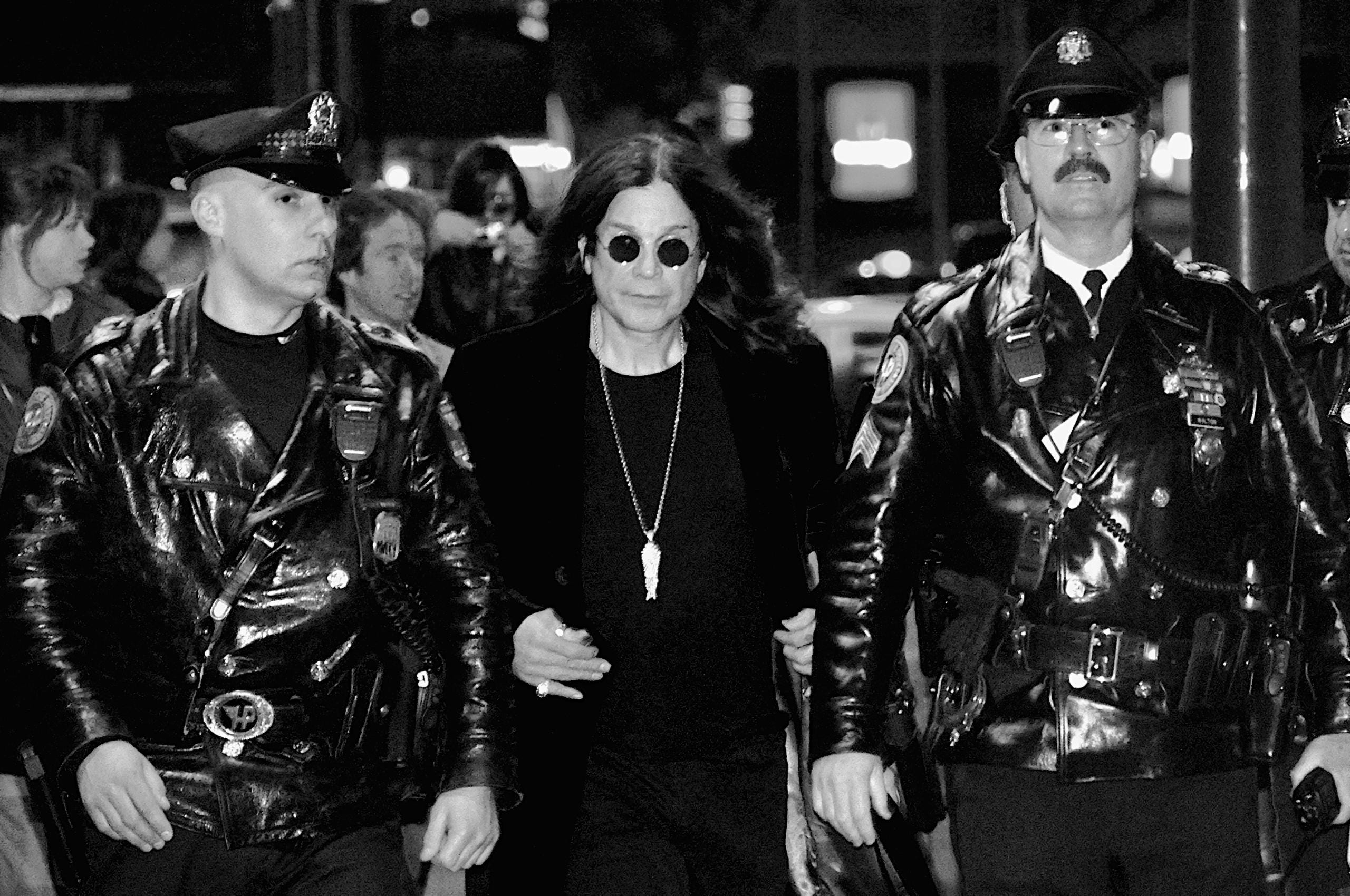
Photograph courtesy of Kevin Burkett. Published under a Creative Commons license.