
Breaking With British Colonialism
The Story of The Voice

By Josh White
The story of The Voice is a story about Black Britain.
The newspaper has been a fixture of Black British media for five decades now, managing to survive economic pressure, the death of its founder, Val McCalla and the rise of the internet.
Yet the legacy of The Voice has been complicated, both by its radical roots and its need to turn a profit.
While antedated by other Black-owned publications —for example, the West Indian Gazette was launched by Claudia Jones in the 1950s—The Voice was the first with national ambitions.
That has made the newspaper a target, at times. Even though The Voice initially built its reputation on anti-establishment politics, critics have derisively referred to it as “The Black Sun”.
For some critics, the newspaper has been too willing to make compromises in the name of profit. Others offer a more nuanced critique, noting that even if The Voice takes on subjects that mainstream publications ignore, it doesn’t always treat them critically.
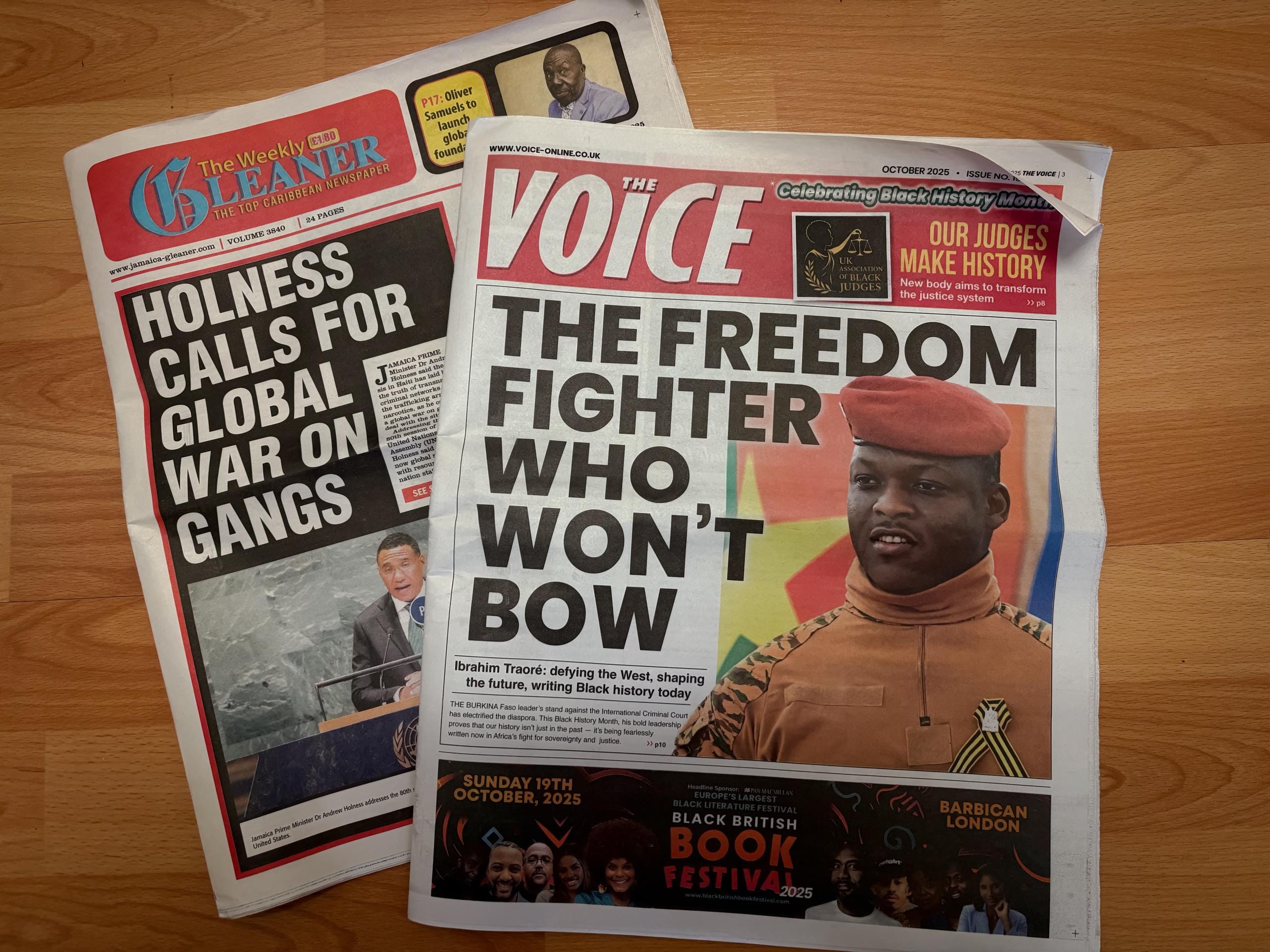
A recent issue featured Burkina Faso’s leader Ibrahim Traoré on the front page. Better him than Keir Starmer, some would rightly say.
But Traoré is a bad imitation of a revolutionary African leader. He is no Thomas Sankara. His politics are more conservative nationalist than radical socialist. His opposition to French influence is matched by an affinity for Vladimir Putin’s Russia.
While at least some of The Voice’s current staffers are clinging to the newspaper’s early years, when it consistently challenged the reactionary excesses of Thatcherism, the decision to platform Traoré so prominently indicates a failure to distinguish between the present and the past. If the rumours of Traoré’s ties to the Russian paramilitary organisation the Wagner Group are true, he is definitely not an avatar of West African independence.
But you can’t reduce a newspaper to its front page. The history of The Voice merits closer examination.
Carnival Paper
The first edition of The Voice was handed out at Notting Hill Carnival 1982. Although only 4,000 copies were sold during its first week, that figure would increase more than tenfold by 1990.
That’s hard-won growth in an era of strife, a testament to what the newspaper was doing right.
In the early 1980s, the United Kingdom was a hotbed of racial tensions and industrial disputes. Margaret Thatcher was determined to remake Britain at all costs. Even tipping the country into a deep recession was worth it. But Black Britain didn’t fit into her vision of a return to Victorian liberal values.
Under Thatcher’s leadership, the Tories had deliberately tapped into the racist vote and stole most of the appeal of the National Front by pledging strict controls on refugees and immigrants.
Many British cities exploded in riots in 1981 in the wake of severe spending cuts by the government. In Brixton, Black residents took to the streets to express anger at ongoing police harassment as well as the deaths of 13 Black teenagers in the New Cross Fire.
Needless to say, this wasn’t an easy time for a Black-owned newspaper critical of the government. But The Voice thrived anyway.
It helped that founder Val McCalla was not an ideological purist. Realising that there was no marketable tabloid for a Black audience, he seized the opportunity with seed money from the Greater London Council and a low-interest loan from Barclays Bank, which was controversial because Barclays had done business with South Africa and was a target of the anti-apartheid boycott movement.
McCalla had come to Britain as a 15-year-old from Kingston, Jamaica, in 1959. After serving in the RAF, he became a bookkeeper. He also worked on East End News, a radical newsletter published in his neighbourhood, Bethnal Green, and called his section of the newsletter The Voice.
When McCalla decided to turn The Voice into a stand-alone publication, he initially teamed up with pioneer broadcaster Alex Pascall, the voice of the BBC’s Black Londoners from 1974 to 1988. It was Pascall who helped McCalla secure the necessary funding for the newspaper.
Unfortunately, this partnership would not last. The loan from Barclays drove some people away from the project. It also contributed to a row between McCalla and Pascall before the publication launched. In retaliation, McCalla ordered security to block Pascall’s return from lunch. That was the end of the line for them.
When Steve Pope, one-time editor for The Voice, published an obituary for his former boss in The Guardian, he made sure to note that “McCalla identified the emerging culture of the black British identity and honed it into tabloid form.” But he also compared McCalla to Citizen Kane. His reputation as a hard-nosed, ruthless businessman could make him seem like a miniature version of Rupert Murdoch or Robert Maxwell.
Like Murdoch and Maxwell, McCalla was all about the bottom line at the end of the day. Following their lead, he transformed The Voice into a tabloid, adopting a populist approach to journalism. Unlike those white newspaper barons, however, he kept a low profile and rarely sought out the spotlight for himself.
Nevertheless, The Daily Mail tried to blame McCalla for the 1985 Brixton riot. The Voice’s scathing treatment of police violence was disconcerting for a Middle England worried about losing its identity.
By this time, The Voice had established credibility with its core audience. White critics, by contrast, baulked at the idea of a Black-run newspaper for Black readers.
Like it or not, the UK was changing. The children of the Windrush Generation were not going away, a point driven home by the election of three Black Labour MPs in 1987: Bernie Grant in Tottenham, Diane Abbott in Hackney and Paul Boateng in Brent South.
Although this normalising of multiculturalism benefited The Voice economically, it blunted the newspaper’s radical edge. After setting out to fashion popular, accessible journalism for an audience different from the white middle class or working-class Tories, the newspaper gradually shifted to a safer, more advertiser-friendly position. But staff members at The Voice did their best to sustain its oppositional legacy.
Maurice Mcleod, who was The Voice’s political reporter through the late 1990s, made it clear when I interviewed him that he disagreed with its harsher critics.
“When I joined the paper, many criticised it for having ‘fallen from its peak’ when it felt like a more outspoken voice for the Black community,” he told me. “I thought the work we did was still important and challenged the establishment.”
Mcleod took pride in The Voice’s professionalism. “We had a well-staffed team with three news reporters, one news editor, two arts writers and an arts editor, several subs and the editor. We were able to devote real time to our reporting and covered stories the mainstream wasn’t interested in.”
When McCalla died of liver failure in 2002, at only 58 years of age, many people wondered whether the newspaper would survive for long without its Citizen Kane. Many publications can’t survive without their founding editors. But the operation proved surprisingly resilient.
New Era, Old Media
Over two decades later, The Voice has outlasted many rivals and alternative sources from New Nation to gal-dem. Although McCalla’s creation may not be at the forefront of Black media in the UK, its staying power is impressive.
Two years after McCalla died, Jamaica’s oldest media group The Gleaner Company bought The Voice for £4 million. Later, the London-based paper would outsource its copy-editing to Kingston as a result of this deal. This was deeply ironic, given that The Voice was originally intended to appeal to younger Black British readers, who weren’t interested in reading The Gleaner in their London flats.
The change in ownership reflected other structural changes at the paper. Voice had once maintained a small presence in Birmingham, Bristol and Manchester. Yet the paper eventually closed these offices to centralise its operations in the capital.
The problems of old media are even more difficult for smaller publications to overcome. Making independent journalism financially viable is tougher than ever.
The pressure of profitability leads to cost-cutting measures unless revenue increases. Once The Voice could rely on job adverts for a lucrative advertising base to build around. Such ads raised £100,000 a week at one time, according to Steve Pope. These days are long gone.
Advertising no longer provides the steady income stream it did two decades ago. And subscriptions cannot make up for the loss. As a result, The Voice has transformed from a weekly newspaper to a monthly one, though with an online presence. Survival demands compromise.
In 2022, The Voice turned 40 and ran an anniversary edition, with soon-to-be King Charles serving as guest editor. This decision was a big deal for the paper. And it came as an enormous surprise to its readership and former journalists.
This decision perfectly captured The Voice’s contradictions. A newspaper born in the wake of police violence and riots had now welcomed the head of the royal family into its pages. The same paper that celebrated the struggles against colonialism now embraced the House of Windsor.
These contradictions were there from the start with McCalla. He envisioned a break with Britain’s colonial past and racist present, but wanted Black capitalism to flourish as a result. Rather than reject Thatcherism on principle, he envisioned the development of a Black entrepreneurial class capable of benefiting from it.
McCalla’s vision may have been more about business than politics, but the newspaper is still here today. That’s no small feat in an increasingly uncertain world.
Photograph courtesy of Josh White. All rights reserved.