
Drones From the Urals
Ivan Sonnov and the Music-Industrial Complex

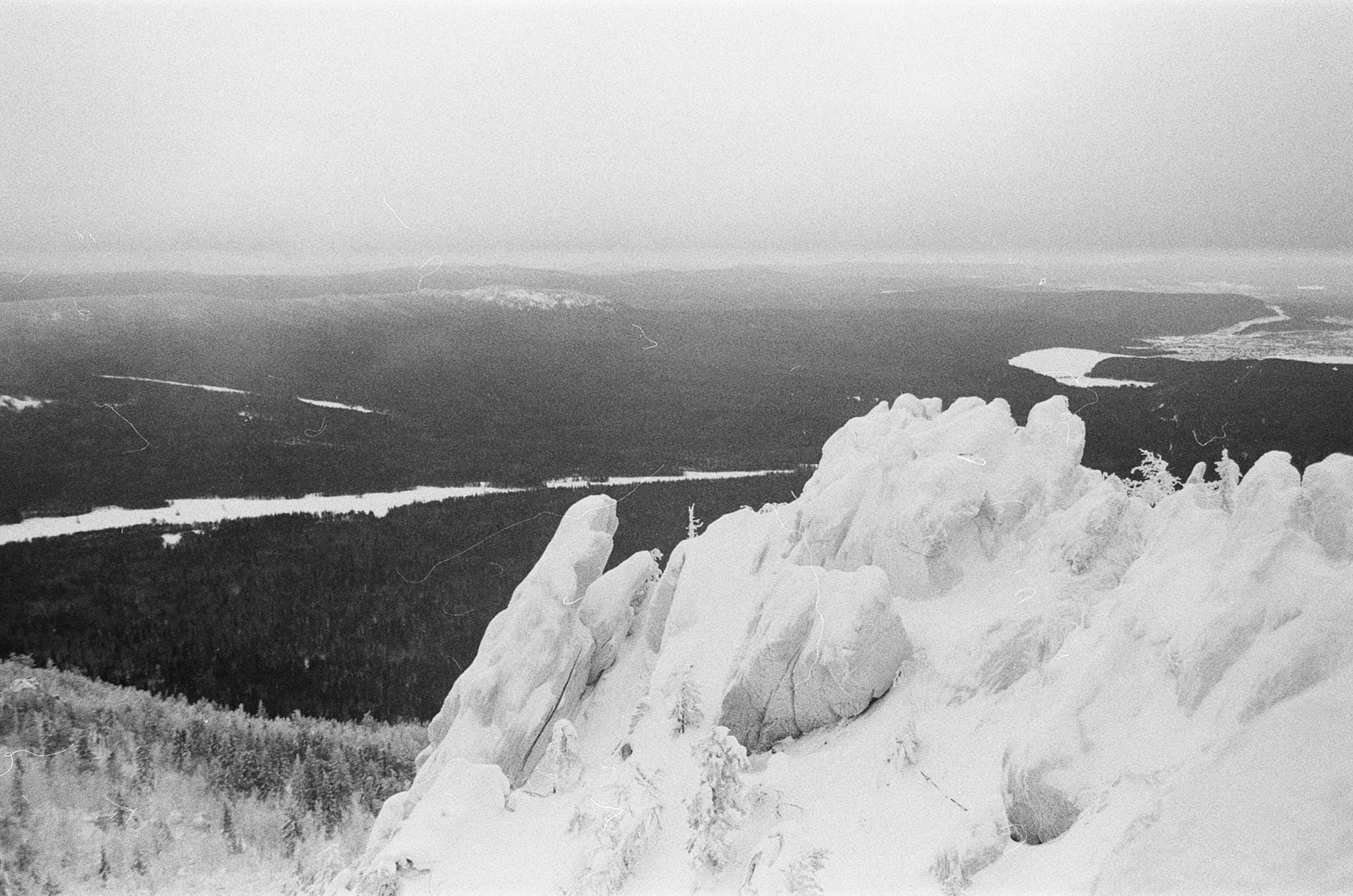
By Charlie Bertsch
How should artists respond to a world in which individual expression is drowned out by the sheer quantity of content bombarding people each day?
For Russian drone musician Ivan Sonnov—real name Иван Гомзиков—the answer is to pick up the pace. He has released more music than most record labels ever have. Way more.
Indeed, Sonnov is a veritable music factory.
At the time I’m writing this, he has an astounding 2,369 releases available for purchase on Bandcamp. And you can own every one of them, as well as forthcoming records, for less than 230 euros, a 90% discount!
On first glance, this might seem like a prank, a way to mock the productivity demanded of us in an era when almost everyone fears being replaced by machines. But the music claims otherwise.
Even though Sonnov’s releases blend together after a while—an inevitable by-product of their sheer quantity—they maintain an impressively high standard. If you like immersive ambient soundscapes, you are sure to find merit in his music.
When I initially tackled his work, I gravitated toward cover designs that aligned with my aesthetic preferences.
Rocojaji, one of many albums released on Bandcamp this month, caught my eye because of its bright red cover. February’s rovekujo appealed because of its visual density, a desaturated close-up of many small flowers. Sonnov ?, from March 2018, looks like a cross-section of granite or perhaps a digital “drip” painting.
Once I began to get my bearings in Sonnov’s vast catalogue, I realised that his recent records usually have an identical structure: ten songs of precisely ten minutes each--100 minutes, in other words--an abstract design on the cover, and no liner notes.
Discerning this rule inspired me to look for exceptions. If there were outliers, I reasoned, they would provide insight into his artistic process.
That’s how I found A Tribute to Eliane Radique, a collaboration with the artist Dark Echo Forest, which does have liner notes, declaring that she is “often referred to as the Drone Godmother” and going on to explain that, “during her musical career, which Radigue began in 1950, she studied with people such as Pierre Schaeffer and Pierre Henri”.
ⅈ, released in December, 2025, features a cover image that clearly references the American television program Twin Peaks, with the iconic zig-zag pattern on the floor and red curtain in the background. Although I couldn’t detect a musical connection to the series, I was surprised to see that it contains a whopping 100 tracks, each 10 minutes long, suggesting it might have a special place in Sonnov’s oeuvre.
And then I hit the jackpot.
I clicked on Angel Forever/A lonely strain, another collaboration with Dark Echo Forest, because I was drawn to the cover, which combines the abstract design principle of other recent Sonnov releases with what appears to be a flame. I began scrolling through its contents with no end in sight. When I finally reached the end of the album, I found that it contains an astounding 286 tracks. That’s nearly two days of continuous music.
Not only that, I found long, deeply personal liner notes.
“My angel, I don’t know if you’ll ever see this message, but thank you for everything you’ve ever done for me. I know and remember that you always wanted to go to Japan and live in Finland. I hope you’re happy. I know you’ve been watching me all these years since we broke up. I don’t know why. I don’t know how. But you did. You can keep watching me, but it’s time for me to move on. I burned all the diaries that reminded me of you. I don’t want to go back to that old life anymore, because after we broke up, my life went downhill.”
Sonnov then proceeds to list all the traumatic experiences he has had over the previous four years, from the loss of his friends and his beloved dog to a near-death experience in 2025, concluding, “It’s as if I’ve been cursed.”
For an artist who otherwise seems reluctant to provide any context for his music, this is an extraordinary statement. And also a perverse one. How likely was it that someone would scrutinise Sonnov’s enormous output carefully enough to read these words?
These liner notes took me back to my own first break-up, when I would sometimes mail my ex two or three heartfelt letters a day. When we got back together, I found them all in a box, unopened. “I couldn’t bear to read them,” my girlfriend told me.
At least I was confident that my letters would reach their destination. Ivan Sonnov couldn’t even count on that.
But maybe the point of this confession wasn’t to communicate with his ex. Maybe he was trying to inaugurate a new relationship with his art.
The fact that Sonnov’s YouTube channel only contains albums released through 2023 suggests a rupture. So does the recent flurry of new material appearing on Bandcamp, which feels subtly different from his previous work.
I’m in awe at the scope of Sonnov’s achievement. It reminds me of famous outsider artists like Henry Darger, who toiled away for decades on projects that had little hope of finding an audience.
On the one hand, Sonnov has the Internet at his disposal, enabling him to connect with people around the world, even from Nevyansk, a city in the Urals far from Moscow.
On the other hand, truly reaching anybody at all in the era of overwhelming cultural slop feels like a fool’s errand.
In this respect, Ivan Sonnov may be the paradigmatic musician of our times, toiling away against impossible odds, sending out message after message, in bottle after bottle.
Photograph courtesy of Maxim Panteleyev. Published under a Creative Commons license.