
Everything is War
The Dragons and the Snakes, by David Kilcullen

By John Foster
Australian military theorist David Kilcullen’s 2020 book The Dragons and the Snakes reads differently in light of the United States' war with Iran.
The Dragons and the Snakes develops the concept of “liminal warfare” to show how adversaries of the West are seeking to counter its strengths.
The old wars are gone.
In their place, Kilcullen argues, something stranger has emerged, a persistent atmosphere of hostility without the clarifying punctuation of war. Traditional declarations of war and the mass mobilisations they entail have given way to conflicts that hover just below the threshold of recognition.
We are no longer sure when war begins or ends.
But the longer we sit with the concept of liminal warfare, the more it feels like a description of symptoms without a diagnosis.
Kilcullen wants to persuade us that we are dealing with a new type of conflict, one that requires adjustment, recalibration, and strategic fine-tuning. What he cannot quite bring himself to consider is that the difficulty may not lie in the novelty of the phenomenon but in the collapse of the distinction that once made such phenomena intelligible.
This reluctance shows up most clearly in his treatment of the first Trump Administration, which he approaches as a turbulent but still legible attempt to reorient American strategy. The Dragons and the Snakes casts Trump as an accidental military theorist, stumbling toward a recognition that the era of counterinsurgency has given way to renewed great-power competition.
Unfortunately, Kilcullen’s optimistic assessment fails to account for the Trump Administration’s chaotic treatment of Iran.
The Joint Comprehensive Plan of Action, a 2015 agreement between Iran, the permanent members of the United Nations Security Council, and the European Union, was supposed to contain the Iranian nuclear program in exchange for a loosening of sanctions.
When Donald Trump decided to withdraw the United States from the agreement in 2018, repudiating the model of international cooperation favoured by his predecessor Barack Obama, and go it alone with a sanctions-based campaign of “maximum pressure”, he dispensed with long-term strategic logic.
The first Trump Administration treated Iran, in rapid succession and often simultaneously, as a near-peer adversary, a sponsor of insurgency, an object of economic strangulation, and a regime teetering on the edge of collapse.
Then came the assassination of Qassem Soleimani in January 2020, to puncture the haze. Here, at last, was something that looked like war in the older sense: a direct, attributable act of lethal force against a senior military figure of a sovereign state.
For a moment, the distinction between war and not-war seemed to reassert itself. And then, just as quickly, it dissolved again. Iran’s retaliatory strikes were absorbed into a narrative of restraint.
The escalation that had seemed imminent simply refused to become war.
As the case of Iran demonstrates, Kilcullen’s notion of liminal warfare lacks self-reflexivity.
He locates ambiguity in the actions of the United States’ adversaries. It’s something that Russia, China, and Iran do, a tactic designed to remain below the threshold of open conflict.
What the Trump Administration’s handling of Tehran suggests, however, is that the ambiguity originated closer to home. The United States wasn’t simply responding to a grey-zone world, but producing one.
This instability is mirrored in Kilcullen’s historical imagination.
The Dragons and the Snakes treats the Byzantine Empire as a patron saint of liminality, a state which survived by avoiding decisive engagements, preferring to operate through diplomacy, deception, and indirect action.
There is something appealing in this image, especially for a strategic culture chastened by the failures of large-scale intervention. It offers the promise of continuity without commitment, of influence without exposure.
Yet the analogy rests on a picture of the late Roman world that is no longer in line with current historical research. The story of a civilised empire overwhelmed by barbarian invaders has given way to a more complicated account in which the distinction between Roman and non-Roman had already begun to erode well before the so-called barbarian invasions.
Gothic elites spoke Latin, adopted Roman legal practices, and served in Roman armies. Power circulated through hybrid arrangements—federal troops, semi-autonomous regions, negotiated settlements—that blurred the line between imperial authority and its challengers.
The crisis of the Western Roman Empire was never simply a matter of external pressure but rather a system in which the categories of inside and outside had lost their clarity.
Read in this light, the example of Byzantium takes on a different significance. It is not a model for defending a coherent civilisation against external threats. The “barbarians” were not outside the system in any simple sense; they were participants in it, operating within its languages and institutions even as they transformed them.
This is uncomfortably close to the situation Kilcullen is trying to describe.
The actors he identifies as practitioners of liminal warfare—Russia, China, and Iran—are not external to the global order in which they operate. They are deeply embedded within it, fluent in its economic mechanisms, adept at its legal forms, capable of manipulating its information flows.
They do not stand at the gates. They move through the corridors.
This embeddedness further erodes the distinction between war and not war. When adversaries sustain conflict through financial systems, legal disputes, media campaigns, and cyber operations, it becomes increasingly difficult to identify the moment at which competition becomes conflict, or conflict becomes war.
The threshold that Kilcullen wants to preserve begins to look less like a tenable distinction and more like a residue, a conceptual artefact that persists even as the practices it was meant to organise slip away. To see how far this slippage has gone, it is useful to step back from his immediate concerns and consider the longer trajectory of thinking about war and politics.
In the classical formulation associated with the early-nineteenth-century Prussian military theorist Carl von Clausewitz, war is the continuation of politics by other means. The relationship between the two is intimate, but the distinction remains. War has its own grammar, its own logic, even if that logic is subordinated to political ends.
The boundary between war and peace is not always easy to draw, but it is assumed to exist.
In his 1927 article “The Concept of the Political,” subsequently expanded into a book, reactionary German thinker Carl Schmitt radicalised Clausewitz’s argument by insisting that the fundamental distinction of political life is between friend and enemy.
War is the moment in which that distinction becomes existentially clear. The possibility of war haunts politics, but it also gives it definition. To identify an enemy is to clarify the stakes of political life.
Postwar French social theorist Michel Foucault turned this argument on its head. Politics, he argued, is the continuation of war by other means.
For Foucault, conflict doesn’t represent an exception to a baseline of peace but the underlying condition of all social relations, diffused through institutions, norms, and practices. In his account, war is no longer a discrete event but a pervasive structure, often hidden, sometimes visible, always operative.
By the time we arrive at the conception of “unrestricted warfare” advanced by Chinese theorists Qiao Liang and Wang Xiangsui, even the residual distinction between domains had begun to disappear.
In their argument, war is no longer confined to the battlefield or even to the military sphere. Economic policy, legal regimes, media systems, and environmental interventions all become potential instruments of conflict. Within such a framework, the boundary between war and non-war becomes increasingly untenable.
Kilcullen’s notion of liminal warfare occupies an uneasy position at the end of this trajectory. He recognises that conflict has migrated into spaces that resist traditional classification, that the friend–enemy distinction has become blurred, and that the threshold between war and peace is difficult to identify. But he remains committed to the idea that this threshold can be managed.
Today, The Dragons and the Snakes reads more like a document of transition than a definitive account of a new strategic environment.
Kilcullen was right to sense that something had changed, that the wars of the early twenty-first century had given way to a different configuration of conflict. He was also right to insist that this configuration demands our attention and cannot be ignored or wished away. But his argument doesn’t go far enough.
The problem is not simply that war has moved into the grey zone. It is that the distinction that made the grey zone intelligible has itself begun to dissolve.
In a world where states act without declaring war, where adversaries operate within shared systems, where conflict is conducted through economic and informational means as much as through violence, the line between war and non-war becomes less a boundary than a memory.
And yet the memory persists.
We continue to speak of war and peace as if they were discrete conditions, even as our practices undermine that distinction.
We continue to look for thresholds, for moments of transition, for events that would allow us to say that war has begun or ended.
Kilcullen’s concept of liminal warfare captures this tension. It names the space in which the old categories no longer quite apply, but also preserves them, holding open the possibility that the distinction between war and non-war might still be recovered.
It’s hard to say whether that recovery is possible.
What does seem clear is that maintaining the distinction between war and non-war in the face of mounting evidence to the contrary risks distorting our perception of the world we inhabit.
Kilcullen’s dragons and the snakes are not simply new kinds of adversaries, operating in novel ways. They are signs of a deeper transformation, leaving us to navigate a landscape in which war is everywhere and nowhere, at once pervasive and elusive, impossible to escape and difficult to name.
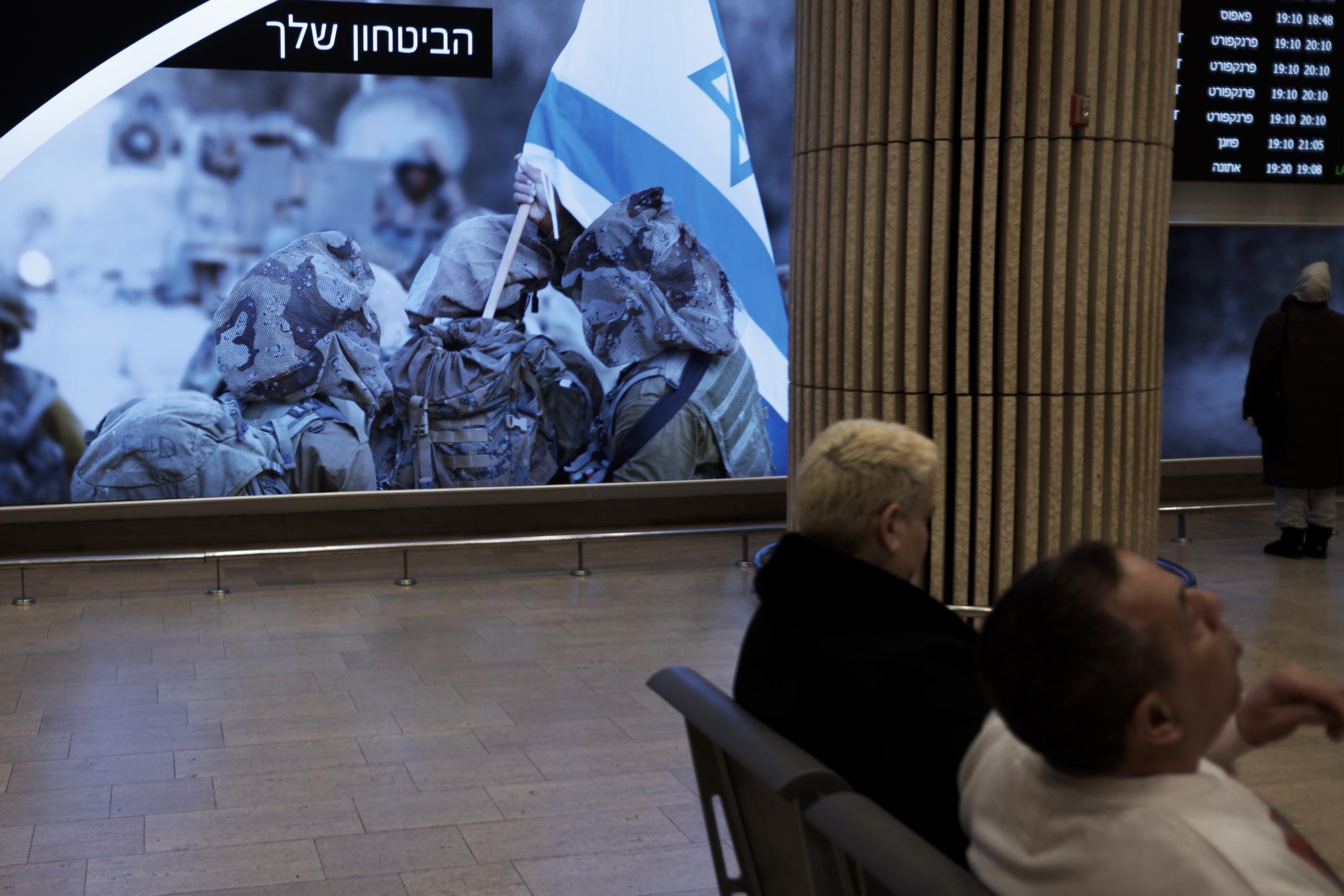
Photograph courtesy of Joel Schalit. All rights reserved.