
Excavating the Future
The Genius of Alexander Kluge

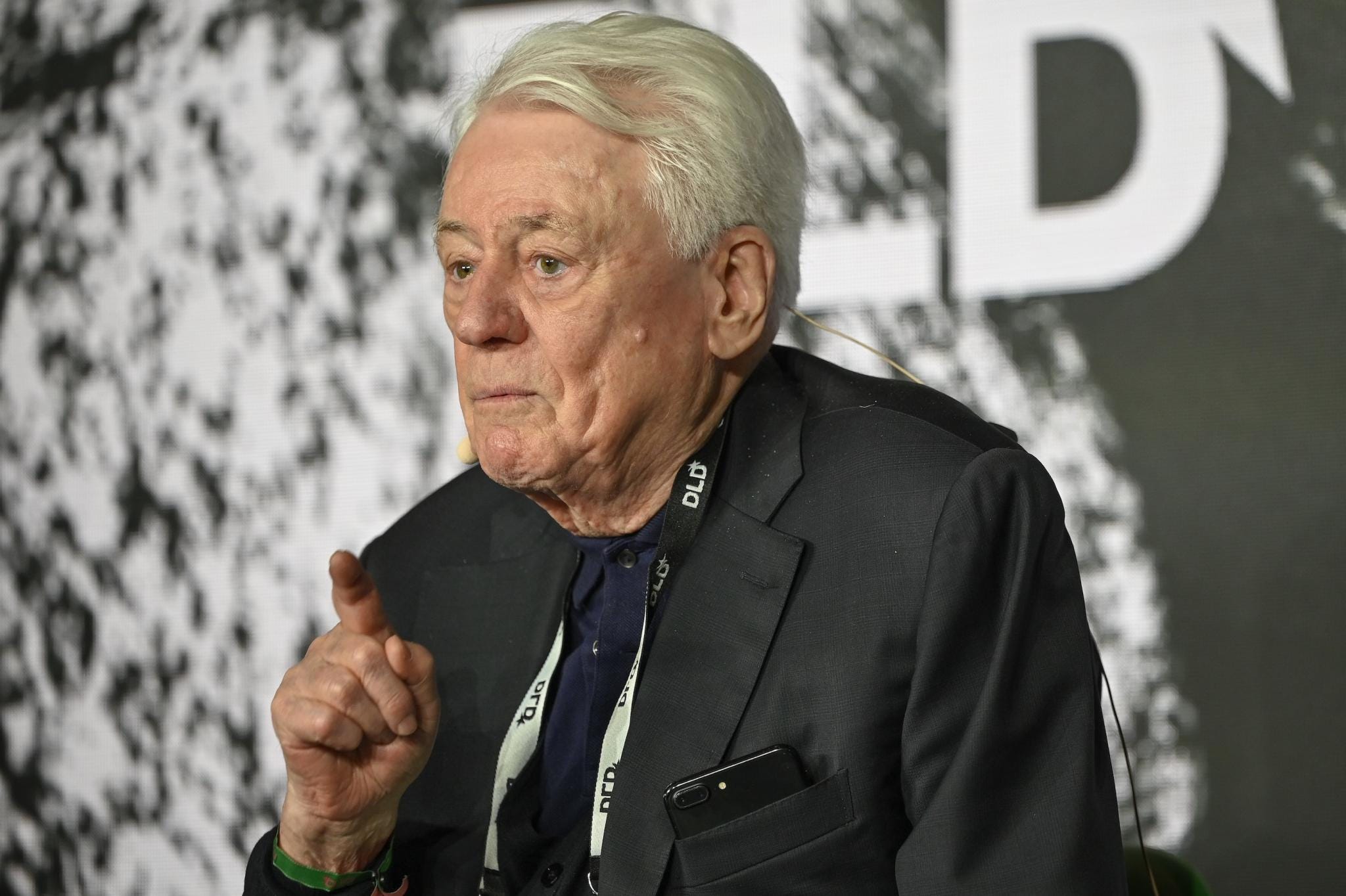
By Charlie Bertsch
Alexander Kluge’s 1979 film The Patriot demonstrates that he was a great thinker more than a great director.
By turns exhilarating and maddening, The Patriot repudiates mainstream conceptions of what cinema should be, refusing the narrative and stylistic satisfactions that moviegoers expect without realising it.
Although Kluge made memorable sequences that move both the body and mind, producing homogeneous works was not a priority.
While this makes The Patriot hard to watch in one sitting, that difficulty is instructive, drawing attention to the unconscious mechanisms that shape the medium.
As the film’s narrator informs us, the eponymous patriot is Gabi Teichert, a teacher of German history who finds her subject lacking, because “it’s hard to fit within a patriotic framework”.
Given how the term “patriot” resonated in postwar West Germany, this description seems to cast the protagonist as someone with right-wing leanings. But it’s hard to square this implication with Teichert’s cheerful earnestness.
When we watch Teichert head out the door with her shovel, hoping to find a better “starting point” by excavating layers of Germany’s past, the impression we get is that she is naïve but well-intentioned, someone we might now identify as being on the autism spectrum.
Significantly, the film doesn’t introduce its main character for over six minutes and repeatedly breaks away from her story for interludes featuring documentary footage and German landscapes.
Further complicating matters, the deadpan voice-over supposedly comes from beyond the grave, spoken by a dismembered knee.
These narrative techniques manage to distance us from Gabi Teichert without inspiring derision or hostility. We scrutinise her passion for digging through history with dispassionate bemusement.
Over and over, Kluge confronts us with disorienting jump cuts.
The first shot of Teichert, bundled up for an expedition in the cold and staring into a mirror, is itself a shock, since up until this point we have only seen a montage of documentary footage, pastoral landscapes, and art.
Even more jarring is The Patriot’s shift, nearly nineteen minutes in, to grainy black-and-white documentary footage of a Social Democratic Party convention featuring a heated debate about whether members should embrace nuclear power or defend the coal industry.
What makes this section of the film especially strange is that we notice recognisable real-world figures like Chancellor Helmut Schmidt and former Chancellor Willi Brandt, while also watching the made-up character of Gabi Teichert confound delegates with her questions about how to revise German history to make it less depressing for students.
History and fiction now form a Moebius strip, the distinction between them no longer demarcated by changes in film stock.
Needless to say, this was not the sort of fare likely to achieve box office success in the late 1970s, when film industries worldwide were turning away from challenging work in favour of pictures with blockbuster potential.
Yet as American filmmaker Michael Moore would later demonstrate with his surprise hits, Bowling for Columbine and Fahrenheit 9/11, Kluge’s use of discontinuity editing and found footage in The Patriot was ahead of its time, a harbinger of the internet-centred post-cinema that now captivates audiences reluctant to spend money on a traditional trip to the movie theatre.
The Patriot was not the work of a young man. Kluge had been making films for nearly two decades by the time it came out. But he was something of a Benjamin Button figure, becoming more aesthetically radical with age.
Kluge’s death last week at the age of 94, shortly after that of Jürgen Habermas, signalled the end of an era. Both were key contributors to the postwar reconstitution of the Frankfurt School and worked with Theodor W. Adorno there.
But whereas history seemed to have left Habermas and his “unfinished project of Enlightenment” behind, Kluge somehow managed to stay on the cutting edge long after most artists have retreated into the tried and true.
Kluge’s last two films, Cosmic Miniatures and Primitive Diversity, both released after he had turned 90, dove straight into debates about the role of AI in the creative process, enthusiastically embracing the new technology’s facility for making the world strange.
Like The Patriot before them, these last works exemplify the director’s commitment to inspiring audiences to think about what they are witnessing rather than just passively feeling it.
Instead of creating a self-contained world, Kluge’s films continually blurred the boundary between inside and outside, reminding us how much work is required to separate life from art.
This attentiveness to ideological closure distinguishes Kluge from his theoretical mentor Habermas, whose tenure book, The Structural Transformation of the Public Sphere, inspired the two volumes that Kluge wrote with Oscar Negt, Public Sphere and Experience and History and Obstinacy.
Whereas Habermas’s research interests and personal inclination pushed him away from direct engagement with aesthetics and, unfortunately, toward a hardening of his theoretical arteries, Kluge spent the majority of his career doubling as both an artist and educator.
Although Kluge had trained to be a lawyer and assisted the Frankfurt School in that capacity, he regarded himself as a creative writer first and foremost, specialising in short stories.
Kluge’s cinematic career was a happy accident. At Adorno’s suggestion, he served as an assistant on one of celebrated director Fritz Lang’s late films, The Tiger of Eschnapur, in the late 1950s.
Kluge directed his first film, Brutality in Stone, shortly afterwards, pivoting away from the professional studio techniques employed by Lang to a method of repurposing old footage, in this case, propaganda films from the Third Reich featuring the Nazi Party’s rally grounds in Nuremberg.
While Kluge would go on to make more conventional films, the use of “found footage” remained a cornerstone of his cinematic practice, as The Patriot testifies.
What sets Kluge’s approach apart from other filmmakers who have deployed this type of material for discontinuous montage sequences—including predecessors such as Guy Debord and successors such as Michael Moore and the late-career Jean-Luc Godard—is his use of “classical” music.
Despite being acutely aware of stories about how Nazis perceived no contradiction between listening to Brahms and Beethoven and committing acts of unspeakable brutality, Kluge still discerns the potential for redemption in Germany’s rich musical heritage.
When we see Gabi Teichert trudging through snow to the accompaniment of solo piano music from the Romantic era, the beauty of the melody overwhelms the impulse to reduce cultural patriotism to a subset of its political counterpart.
Towards the end of the film, after Teichert’s initial optimism has soured into frazzled disillusionment, we see her sitting in her classroom, looking out at her students, who exhibit the aggravated boredom of teenagers who would rather be anywhere else than school.
The lovely Baroque music that plays over these shots, dominated by sunny brass instruments, contrasts sharply with the dour mood.
This non-diegetic soundtrack serves as a bridge, following another montage of still images, to the following scene featuring Teichert, in which we see her weeping behind the wheel of her car.
Kluge holds this shot for an uncomfortably long time. This contrasts with the rapid-fire cuts elsewhere in the film, reinforcing our sense that the forward progress of Teichert’s quest has ground to a halt.
Although the narrator later explains that New Year’s Eve gives Teichert new hope, reviving her search for a better starting point for the teaching of German history, it’s hardly a happy ending.
As the voice-over reminds us, history isn’t soft or pretty.
Despite all the bleak content filling The Patriot, the film’s open-ended construction imbues audiences with a sense of agency absent from more coherent narratives.
That’s why it matters that the narrator is only one part of a human being, a knee, and a dead one at that.
The pursuit of completeness, a story in which everything hangs together, inevitably leads to misadventure. It’s only in fragments that redemption can be found.
While that’s a primary conceit of German Romanticism, it’s also ideally suited for making sense of the world that confronts us today, in which AI reflects our own labour back to us like a spinning disco ball.
Alexander Kluge’s body may have failed. But his disembodied voice lives on, reminding us that historians must never turn their backs on the future.
Photograph courtesy of Hubert Burda Media. Published under a Creative Commons license.