
Fascist Agitation Lesson
Unite the Kingdom, Part I

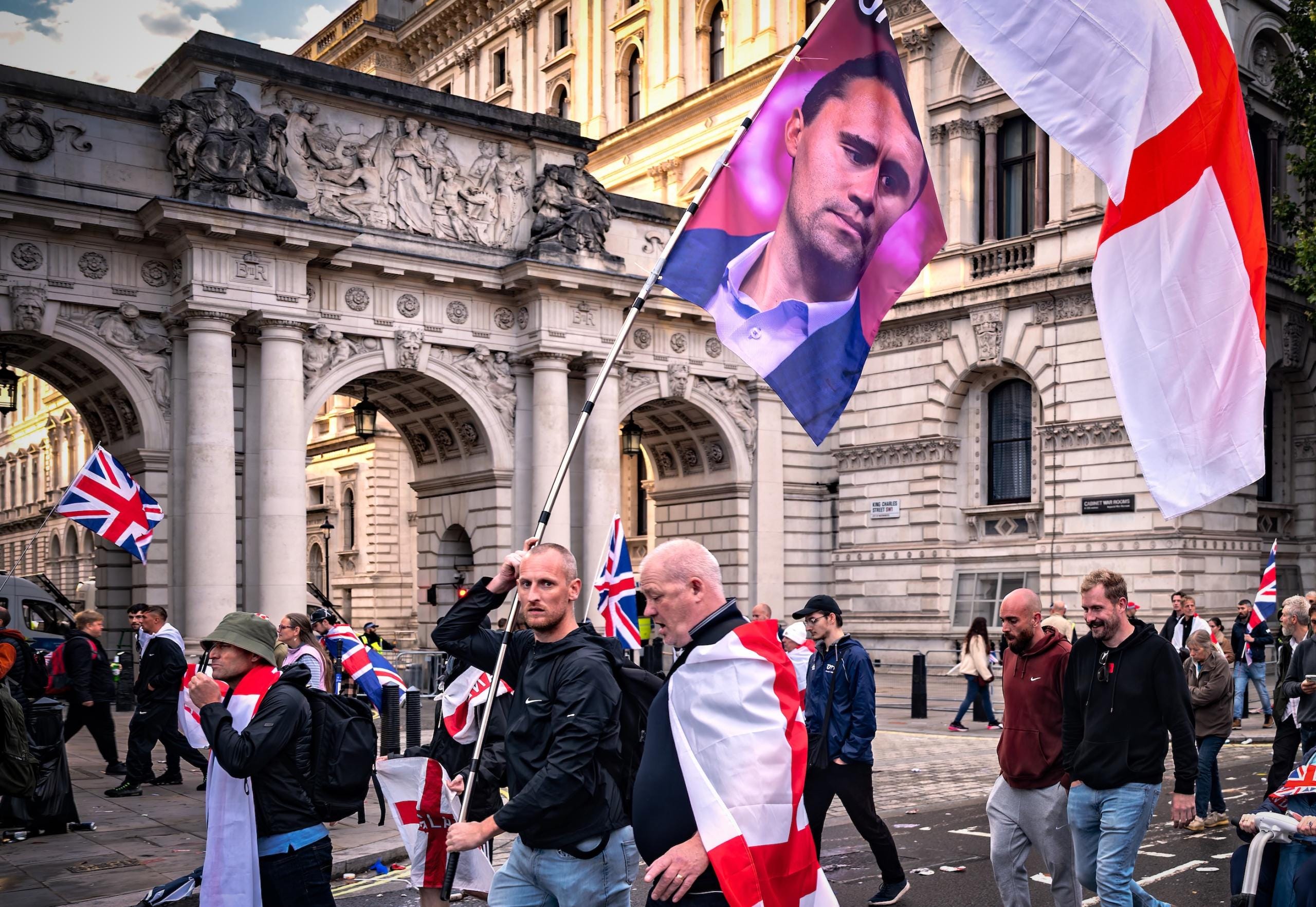
By John Foster
Unite the Kingdom told us less about what Britain is than about what some extremists want it to be. Or, more accurately, what they want to believe it was.
The rally had a name that could have been dreamed up by a committee of provincial men in cheap suits and rented enthusiasm, suggesting that the UK could be put back together again with a day in the park, a few speeches about immigrants, and a merch table stacked with T-shirts in the wrong sizes.
The branding was genuine, a notable achievement at a time when irony is woven into the language of political discourse.
To call the event “Unite the Kingdom” was to risk sincerity, as if repetition alone could mend a fractured island and translate nostalgia into policy.
Tommy Robinson strode into the gathering like a man returning to his element.
Born Stephen Christopher Yaxley-Lennon, the far-right agitator has perfected a particular style of performance: half-brawler, half-victim, a man perpetually wronged by an establishment that is simultaneously persecuting him and too weak to stop him.
It’s a deliberately contradictory act. Contradictions create the aura of martyrdom, and martyrdom is the most reliable currency of populist politics.
To Robinson’s followers, he isn’t just a man with a megaphone and a social media channel, but the embodiment of a national grievance, a symbol that Britain itself has been taken away from them, parcelled out to faceless bureaucrats in Brussels, global financiers, or—most reliably—the immigrants down the road.
There is something faintly comic in Robinson’s persona. But it’s comedy of an unsettling variety. He is the sort of character you expect to encounter in the opening scenes of a satire, his bluster setting the stage for darker things to come.
Tommy Robinson has the bearing of a man who has read half a book about Churchill and decided that bulldog tenacity can be replicated with shouting and a pugnacious stance.
To watch him work a crowd is to witness a kind of music-hall routine in which every joke has the same punchline: the country has been stolen, and only by following his lead can it be reclaimed.
Yet there is also menace there, of someone who knows that even if the jokes fall flat, enough people are willing to laugh anyway.
Rallies like Unite the Kingdom are not the product of a confident nation, but of a disoriented one, a country that has seen the pillars of its industrial economy pulled away, its institutions hollowed out, and its political leadership reduced to a slurry of managerialism and opportunism.
When Robinson takes the stage, he does not need to provide a coherent account of policy. He does not need to articulate a plan for fixing the National Health Service or reviving manufacturing in the Midlands. He only needs to point, in broad strokes, at the supposed culprits; his audience fills in the rest.
The crowd at Unite the Kingdom was revealing, a mix of the perpetually angry, the curiously detached, and the merely bored.
Some men looked as if they hadn’t left their local pub in decades. Women clutched their handbags as if the marchers themselves might steal from them. Teenagers sported the blank expressions of those who hadn’t yet figured out what they stand for but were happy to document the proceedings for TikTok.
Flags fluttered, their purpose more decorative than patriotic. Hanging over everything was the feeling that the United Kingdom, once known for its decorum in public spectacles, had chosen a cruder, brasher carnival.
Robinson enjoyed the atmosphere. He has always been more of a provocateur than a politician, more captivated by the spectacle of outrage than by turning it into legislative action.
The latter involves the tedious work of compromise and policymaking, which are foreign to his nature. Instead, Robinson thrives on moments of confrontation, whether with the police, journalists, or the vague shadow of an “elite” that mainly serves as a foil for his paranoid monologues.
If politics in Britain has increasingly become a stage act performed for cameras, Robinson is its most shameless actor, a thug who prefers to be infamous rather than ignored.
And yet, it would be wrong to dismiss him. The success of a rally like United the Kingdom is not measured in how many people attend, nor in the coherence of its message, but in the way it taps into an undercurrent of despair and disillusionment.
The UK’s decline has been slow enough to avoid a spectacular front-page collapse, but steady enough to shape the consciousness of its citizens.
The factories that once provided secure work have long since moved to cheaper pastures. The unions that once gave workers leverage have been defanged. The state that once promised cradle-to-grave security offers little more than delays, cutbacks, and the occasional scolding lecture on fiscal responsibility.
Against this backdrop, Tommy Robinson’s crude nostalgia, his insistence that the country has been betrayed, resonates not because it explains reality but because it offers a simple story in a world that has grown too complex to understand.
There is also the peculiar British fondness for eccentrics, which allows even Robinson’s most theatrical flourishes to be seen as roguish charm.
The United Kingdom has always embraced its loudmouthed gadflies, from the backbenches of Parliament to the pages of the tabloids. What sets Robinson apart is that his eccentricity is predatory, not harmless.
His jokes are barbed, his grievances easily translatable into hostility against the vulnerable. In another age, he might have been a character in a satirical novel, his absurdities exaggerated for comic effect. Instead, Robinson is a very real presence, and his rallies are symptoms of a deeper malaise that satire alone cannot contain.
So Unite the Kingdom was less a celebration than a symptom, less a victory than a diagnosis. It showed us a Britain eager to laugh at its own decline, provided the jokes were pointed at someone else.
Unite the Kingdom revealed a politics that no longer believes in governing so much as in feigning grievance, and a citizenry that no longer asks for solutions so much as for stories.
At the centre is Tommy Robinson, a fascist who discovered that in a fractured kingdom, there is profit to be made in promising unity, provided it is defined as an angry chorus shouting in unison.
Even if the rally had just consisted of Robinson and his entourage of aggrieved patriots, it would have been easy to classify it as another footnote in the UK’s long descent into provincial melodrama.
However, the day acquired an extraordinary gloss—like an amateur theatrical performance that had somehow lured a famous actor into its cast—when Elon Musk decided to make an appearance.
In many respects, Musk is the perfect guest star for such an event: fabulously wealthy, erratic, addicted to attention, and perpetually performing the role of a visionary genius who spends too much time scrolling Telegram channels.
The billionaire’s remarks to the assembled crowd were brief but unmistakably apocalyptic: “Violence is coming to you,” he intoned, before adding that they would have to “fight or die.”
This is the kind of declaration you might expect from a video game villain or an unemployed actor auditioning for a dystopian TV drama.
Coming from Elon Musk, it possessed that particular quality of grandiose vagueness that makes listeners wonder whether it was meant as prophecy, threat, or simply another in his long list of impulsive outbursts. But in the context of a resentment rally, it carried just enough gravity to make the headlines.
Musk has always had a knack for straddling the line between absurdity and menace. Within the span of a single news cycle, he can be described as a technological visionary bent on colonising Mars and as an online troll recycling memes better left on Reddit in 2010.
The South African entrepreneur’s relationship with racism has followed a similarly contradictory trajectory: one day condemning xenophobia in lofty terms, the next amplifying dog whistles to millions of followers on his platform, which he insists is a beacon of free speech even as it haemorrhages advertisers and credibility.
To ask whether Musk is or isn’t a racist is, in this sense, to miss the point. He is, above all, a mirror: reflecting whatever prejudices and aspirations his audience brings to him, polishing them up with a coat of bravado, and returning them in a form that feels both transgressive and strangely flattering.
That he should appear in the UK, of all places, to warn of imminent violence, is itself an irony of global capitalism.
Elon Musk is not invested in Britain’s future, except insofar as it serves as a new stage for his own performance. His companies have a small presence here compared to the United States and China, and his interventions in UK politics have traditionally ranged from the eccentric—such as dismissing a Thai cave rescuer as a “pedo guy”—to the opportunistic. For this rally, none of that mattered.
What did was that a man widely described as the richest person in the world had stood on their stage and lent his imprimatur to their anger. For Robinson, it was a coup; for Musk, it was a casual afternoon’s entertainment, the sort of thing he might forget by morning in favour of a new controversy.
The reaction from the British government was, predictably, one of carefully calibrated outrage. Prime Minister Keir Starmer’s office released a statement expressing revulsion at Musk’s comments, noting that calls to violence have no place in British political discourse.
The statement was dutifully reported in the press, accompanied by the requisite quotations from backbenchers, commentators, and a handful of business leaders who feared that Musk’s antics might damage Britain’s reputation for stability.
And then? Nothing.
No effort to censure Musk, no attempt to bar him from future appearances, no initiative to curtail the spread of his remarks online. The entire performance of revulsion was, in fact, designed to accomplish precisely that: a public display of disapproval that reassures the respectable classes while ensuring that nothing is actually done.
It is tempting to view this as cowardice, but it is perhaps more accurately characterised as a habit.
Keir Starmer’s government has turned the art of inertia into a technocratic virtue, framing every crisis as a management issue rather than a political one. Musk’s comments, presented in this way, were less a threat to democracy than an unfortunate distraction, best dealt with with a raised eyebrow and then ignored.
Negative reinforcement, the sort that might actually discourage future performances, was ruled out not because it was impossible but because it was unfamiliar.
Neoliberal governments of Starmer’s Labour are allergic to confrontation unless it comes in the form of polite negotiations with the bond markets. To confront Elon Musk would be to risk turning him into a martyr of free speech, and worse, to admit that Britain’s democracy is fragile enough to be rattled by an errant oligarch.
As a consequence, the spectacle passed, absorbed into the news cycle and gradually replaced by fresh absurdities. Musk flew back to whichever of his residences seemed most convenient. Tommy Robinson basked in the afterglow of having shared a stage with the global elite. The prime minister’s aides checked the polls and reassured themselves that no real damage had been done.
In this choreography, every player fulfilled their role: the provocateur stirring the pot, the billionaire lending star power, the government playing the part of exasperated parent pretending to scold while enabling.
It was a perfect microcosm of UK politics: loud, chaotic, briefly terrifying, and then promptly forgotten, leaving behind no solutions but plenty of resentment.
Photograph courtesy of johnlsl. Published under a Creative Commons license.