
Forever Immortal
A Little Death, by Claire Rousay

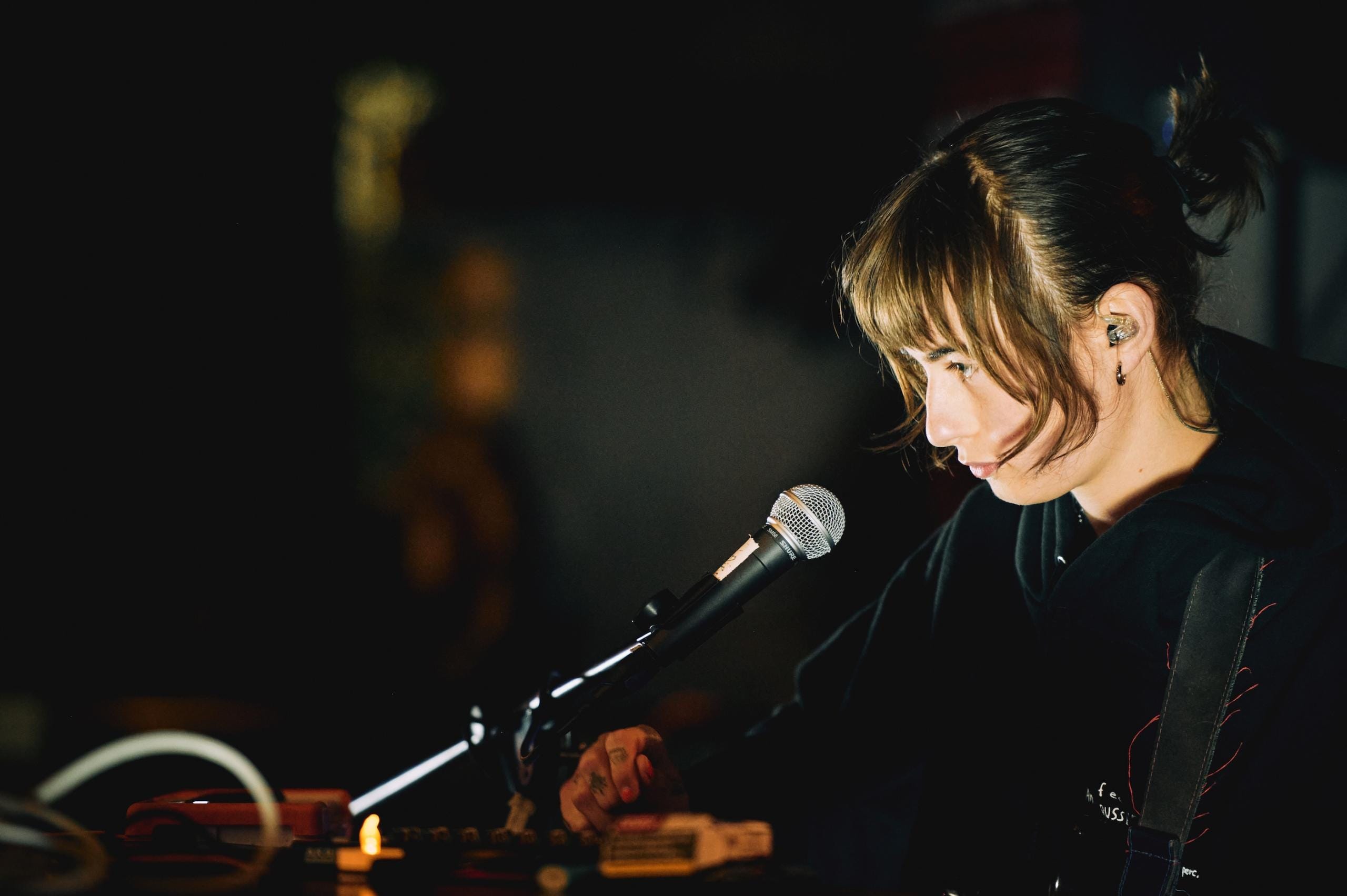
By Charlie Bertsch
Claire Rousay’s latest album A Little Death confirms her unparalleled talent for combining field recordings and conventional music-making.
The album’s fourth track, “Somehow”, leads off with a hum and hiss, precisely the sort of sounds that normally get filtered out during the production process. Slowly, that hum grows into a slowly pulsing chord as the hiss mounts to keep pace.
Fragmented guitar and violin then enter the mix, recorded to emphasise the incidental noises of human fingers sliding across strings, rather than the notes themselves. At times, the pregnant busy-ness of the music recalls another fabulous record released by Thrill Jockey Records, Califone’s 2006 album Roots & Crowns.
This aesthetic is sometimes employed in alternative music to introduce a proper song, situating it within a context where authenticity takes precedence over fidelity. For Rousay--a Canadian who arrived in Los Angeles by way of Texas--this dirty ambience is the song, not a prelude to something else.
Layered, largely unintelligible vocals start to make their presence felt midway through “Somehow”, increasing volume and building tension. But despite the album’s provocative title, there is no musical release coming.
The only climax is narrative.
In contrast to Rousay’s previous album, the breakthrough 2024 release Sentiment, A Little Death is strangely reticent.
Whereas Sentiment‘s stand-out track “Head” delivers a blunt account of the sexual power dynamics in the giving and receiving of oral pleasure, and “Lover’s Spit Plays in the Background” invokes the viscerally carnal Broken Social Scene song, A Little Death avoids direct references to sex.
Even the eponymous final track seems hesitant to cross the border into ecstasy, only conjuring that passage in its final moments through some low-volume rapid breathing that never reaches the kind of audible outburst we associate with orgasm.
Nearly four minutes into “Somehow”, the song’s subtle cacophony gives way to a single human voice, a non-native speaker heard loud and clear, obviously recorded in a noisy public space rather than in studio conditions.
“I was jobless, homeless, and really heartbroken. And there was this concert coming out in my city. . . And I thought it would have been really nice to listen to some quality musics, at least, if I can’t have basic things in life.”
The speaker proceeds to tell the story of reaching out to the artist on social media, asking for a pass to the show, only to be ignored and then blocked.
“It can’t go much worse from that point on. I was, like, no, I’m not even thinking about going to this person’s concert and buying their merch or anything supporting them. And two years later, I’m here. This person was Claire Rousay.”
“Somehow” ends abruptly with that punchline, a reminder that even a comparatively unfamous trans artist like Rousay, committed to political and personal inclusiveness, must set boundaries that could hurt someone unable to cross them, but also that there is hope for a musical reconciliation, incorporating this person’s voice as a crucial musical element.
Descriptions of Rousay’s work typically lead with the approach she takes in constructing a track like “Somehow,” integrating sounds captured in everyday life, both human-made and machine-generated.
Using one of the inexpensive handheld field recorders made by Zoom, she collects audio material the way an ambitious vlogger captures video, understanding that creative possibilities are greatly magnified when there’s more content to choose from.
In other words, the ratio between what Rousay records and what she actually ends up using is very high. The vast majority of her raw material ends up on the proverbial cutting-room floor.
But what truly sets the tracks on A Little Death apart is not her extensive use of field recordings so much as their integration into a soundscape fashioned from traditional instruments.
Along with Rousay’s acoustic guitar, the album features the clarinet of M. Sage and Gretchen Korsmo, the lap steel of Andrew Weathers, and the violin of Alex Cummingham and frequent collaborator Mari Maurice.
While these instruments are mostly used for textural purposes, the concrete quality of the sounds they make prevents A Little Death from becoming pure audio collage.
Whatever their provenance, the sample-like fragments of guitar, violin, and clarinet ground Rousay’s work in the pursuit of musical pleasure. But that quest is unusually dependent on the conjuring of negative space, encouraging listeners to fantasise the resolution that her songs resist conveying.
Maybe the most accessible track on A Little Death is “Somewhat Burdensome”, in which the ambience of field recordings is dialled back in favour of traditional instruments.
For more than five minutes, sounds swell and subside, continually giving the impression that they are building towards something that never comes. But that frustration, which the album’s title invites us to comprehend in sexual terms, is far more compelling than the average pop song.
Because we have to imagine the vanishing point of “Somewhat Burdensome”, flickering like a mirage on the horizon, our desire isn’t subjugated to the diegesis.
Instead of AC/DC’s famous line, “She told me to come, but I was already there,” A Little Death proffers a soundscape in which the dream of release becomes more powerful and personal precisely because Rousay’s music inhabits the temporal aspect of the always-already-not-there-yet.
The liner notes for A Little Death on the Thrill Jockey website note that the album features field recordings captured at dusk, “as daylight fades into memory”.
This crepuscular quality “give a subtler diaristic impression, the recordings occupying a more elemental space which give moments of absolute clarity a shine in the dim gloaming”.
Put another way, not only do the soundscapes on A Little Death incline in the direction of what young aesthetes call “liminal space”, they double down on that conceptual borderland by grounding themselves in liminal time.
This interest in edges dovetails with Rousay’s interest in coupling recordings of different quality. “Blending fidelities comes from how I started making music on my own,” she explains in the liner notes.
“I started recording myself as a teenager, and I needed two microphones and I had one real one and then my laptop. I’d use them both and find a way to make them work together. These pieces share a lineage with that, using what’s available.”
This way of thinking about fidelity casts the lack of les petites morts on A Little Death in a different light.
When the artist’s priority is connecting things that normally do not go together—in this case recordings of high and low fidelity—it makes sense to delay the satisfactions of both body and mind that inevitably lead to decoupling.
Claire Rousay’s A Little Death is a remarkable achievement, sustaining listeners’ interest with a collage of sounds from divergent sources. It’s a must-have for anybody who loves to think about ambient culture.
Photograph courtesy of Non Event. Published under a Creative Commons license.