
Multicultural Metal
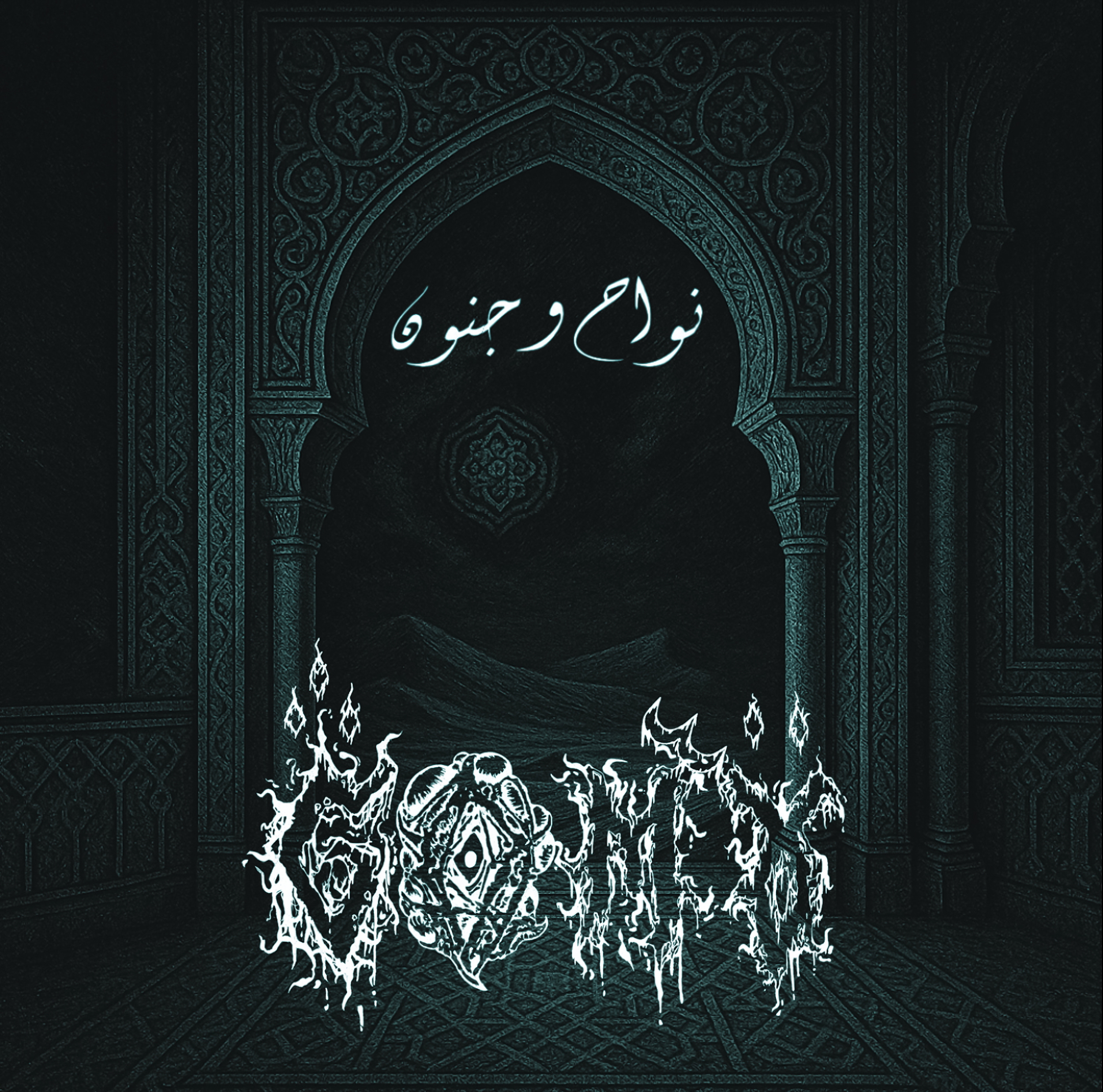
Wailing and Madness, by Gomma

By Charlie Bertsch
Tunisian artist Gomma’s latest album Wailing and Madness (نواح و جنون) subverts mainstream stereotypes about black metal while still delivering the intense experience fans of the subgenre seek.
Much of the music is hard, loud, and bleak, communicating the existential anxiety that is a calling card of black metal.
But the quiet passages go in the opposite direction, using scales and rhythms even musically naïve listeners associate with the predominantly Muslim lands stretching from Morocco to Iran.
If Wailing and Madness had been made by white musicians from northwestern Europe, it would have raised questions about cultural appropriation. That’s how effective the music’s granular details evoke the exoticising impulse Edward Said taught us to identify as Orientalism.
The fourth track, “Dana’at Al-Amr” (دناءة الأمر), is typical. After opening with three sustained keyboard notes and distorted “scratching” that sounds a bit like gunfire, plucked notes on an acoustic stringed instrument, and hand-tapped beats enter the mix, forcibly transporting listeners into a dramatically different world from the one normally conjured by black metal.
After 45 seconds, the music suddenly gets switched on, closing the gap between stereotypes of East and West. And then, about a minute into the song, the vocals come in, scream-sung in a deep register that can make it difficult to identify words, though the song titles make it clear that they are in Arabic.
In an interview about Wailing and Madness with Souhaib Louati, Gomma explained that, while some might describe the record as pessimistic, he doesn’t see it that way.
“It was really an eye-opening experience for me, because the concepts that we usually live by were shattered. I had to learn how to live again. That’s the major idea of the album.”
This sense of a new beginning informed his decision to break with the precedent set by his first album, which contains English-language songs.
“I chose to do it fully in Arabic and with Oriental instruments. The more simple answer would be that, since I’m Tunisian and Arabic is my first language, it’s easier.” But there was more to it than that.
“On the other hand, I wanted it to be more authentic, more national, for myself. I wanted the album to be really reflective of my being. Not just my ideas, but me as a person. The whole album is recorded in Phrygian Dominant. I went full Arabic in all aspects.”
Although there is a stark contrast between the acoustic portions of Wailing and Madness and the thundering electrified ones, the longer you listen to the record, the less it feels like a contradiction.
If Arabic is Gomma’s native idiom, metal is the second language he acquired at a young age.
In his books Heavy Metal Islam and We’ll Play Till We Die, Mark Le Vine explores the countercultural force that this music brings to bear in societies where a combination of religious observance and political repression limit freedom of expression.
“Music can make us stronger, but can music change the world?” LeVine asks in the latter’s epilogue. “At its most potent—and this we have now observed numerous times in the last decades across the Muslim world, especially in places with authoritarian governance—it has the power to create publics.”
But it’s vital to remember both that publics overlap and that people move between them in ways that are difficult to pin down. Sometimes they are torn between identities that seem mutually exclusive. On other occasions, however, they find ways to reconcile the contradictions between them, if only temporarily.
Speaking about future projects in the interview, Gomma indicated that the particular tension between East and West on Wailing and Madness will not be a permanent feature of his work.
“I don’t want to be limited. The first album was melodic. The second album was Oriental. The third album. . . I think I will be going with something like Old Norse.”
He went on to explain that this would mean using “ethnic instruments” associated with Scandinavia, rather than his native land, and would continue singing in Arabic, but might include lyrics in English or Icelandic as well.
“I will really try to hit many cultures,” he added, “many different mythologies, many different vibes.”
In other words, for Gomma, to think in terms of cultural appropriation would be to foreclose the possibility of self-discovery through otherness.
Because Gomma originally released the album himself, before it was picked up by the Portuguese label Hypnotic Dirge, I asked him via email whether the music resonates differently in that European context.
Gomma responded that the re-release has given Wailing and Madness a “second life, another chance to reach places outside my local community and the Arab World”.
Crucially, Hypnotic Dirge explicitly opposes the politically reactionary tendencies associated with black metal and related subgenres, declaring itself proudly anti-fascist.
As Gomma puts, it, the label has “a very distinct identity, that I feel attracted to” and an ideology he shares. By contributing music that falls outside of the traditionally Eurocentric domain of extreme metal, he is helping to extend that vision.
“I do not see it as imitation,” he adds, referring to his deployment of generic conventions identified with Nordic cultures,” but “more like a full-fledged conversation.”
In a world where once-permeable boundaries are being walled off in the name of racial or religious purity, Gomma’s willingness to seek self-knowledge in otherness hits differently.
Wailing and Madness reminds us that it’s still possible to strengthen our own identity without having to demean someone else in the process. The fact that the music is so deeply compelling only makes that lesson sweeter.
Photograph courtesy of Gomma. All rights reserved.