Never-Ending Blame Game
The Cultural Marxism Conspiracy, by A.J.A. Woods

By John Foster
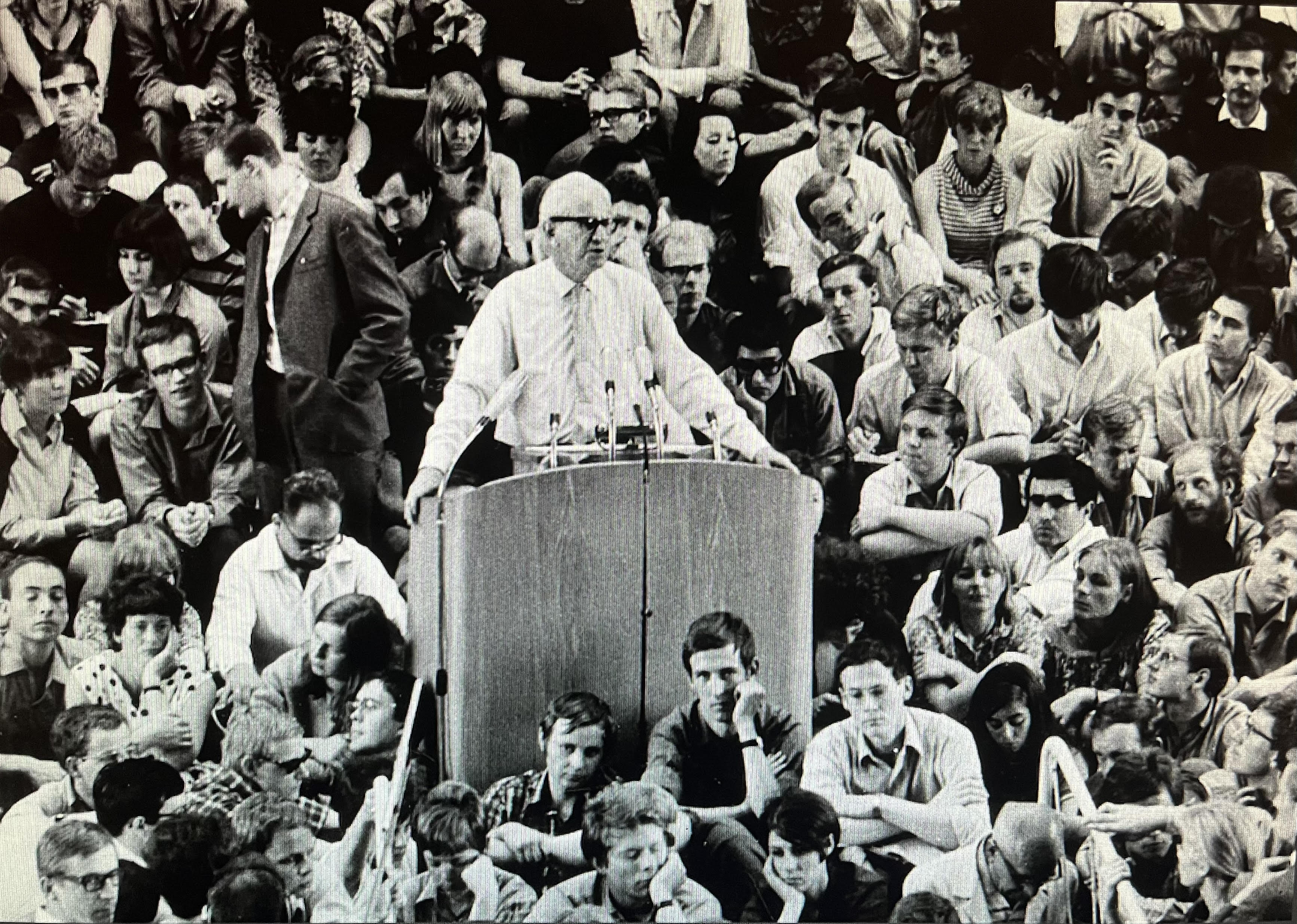
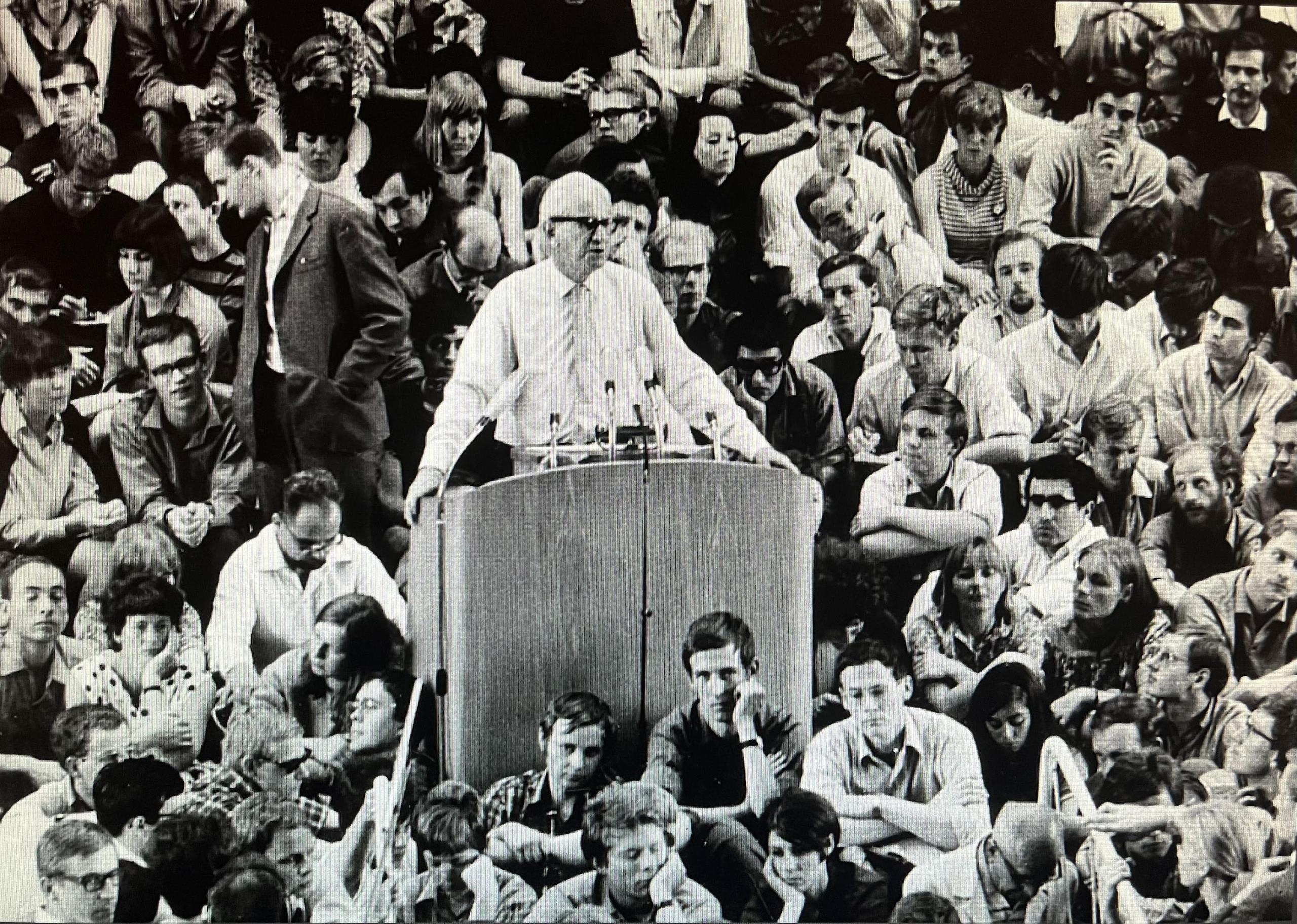
A cabal of mid-century intellectuals, identified with the Frankfurt School, undertook a “long march through the institutions” to dissolve Western civilisation from within.
There is something perversely reassuring about a conspiracy theory that is both durable and coherent. In a world where institutions drift, parties hollow out, and the connection between cause and consequence grows ever more tenuous, the idea that someone, somewhere, is in charge—pulling the strings, coordinating the drift—has a certain grim appeal.
The connivance that A.J.A. Woods’ The Cultural Marxism Conspiracy debunks was already shaping political debate during the counterculture, as movie star John Wayne’s famous 1971 interview with Playboy Magazine demonstrates.
Wayne worries about the impact that Herbert Marcuse is having on young people. At one point, while decrying liberals’ permissiveness, he declares that communists couldn’t start a workers’ revolution in the United States, “since the workers were too affluent and too progressive” and therefore “decided on the next-best thing, and that’s to start on the schools, start on the kids. And they’ve managed to do it. They’re already in colleges; now they’re getting into high schools.”
A half-century later, Wayne’s vision of a long march through the institutions was still percolating through right-wing politics, inspiring a powerful backlash against “wokeness” in educational institutions.
The temptation is to dismiss this conspiracy theory outright.
After all, the supposed architects of this grand cultural subversion—Theodor Adorno, Max Horkheimer, Marcuse—were hardly the type to mastermind a seamless ideological takeover. They were Jewish émigré scholars, often marginal within their own institutions, writing in a register that even sympathetic readers find forbiddingly dense.
Their diagnosis of modern society was suffused with pessimism: a sense that mass culture had become an instrument of integration rather than liberation, that the very possibility of critical consciousness was being eroded by the machinery of advanced capitalism.
Reading the Dialectic of Enlightenment doesn’t provide a triumphant blueprint for cultural domination, but an impression of intractable blockage.
The book is particularly good when Woods lingers over this mismatch between the historical record and the conspiracy theorists’ imaginative reconstruction of it.
The Frankfurt School, in his telling, appears less like a shadowy directorate than a loose, often fractious network of thinkers grappling with the wreckage of European modernity. Their concerns—authoritarianism, mass deception, the fate of reason—were shaped by exile, by the experience of fascism, by the uneasy transplantation into an American academic environment that they could never fully trust.
To transform this intellectual formation into the command centre of a decades-long campaign to erode Western values requires an audacious brand of retrospective mythmaking.
And yet, as Woods insists, the persistence of the Cultural Marxism narrative cannot be explained simply by pointing out its falsity.
Conspiracy theories of this kind do not survive because they are true; they survive because they are useful. They provide a language in which diffuse grievances can be articulated, a framework in which otherwise disconnected experiences can be gathered into a single, intelligible whole.
In this sense, the idea of Cultural Marxism’s influence functions less as a theory than as a condensation. It gathers together anxieties about changing gender norms, racial hierarchies, educational institutions, media ecosystems, and state policies, and attributes them to a single, malevolent source. The messiness of social transformation is replaced by the clarity of intentional design.
What Woods suggests—and what readers might wish he had more forcefully argued—is that this condensation responds to a more general crisis of mediation.
During the era preceding the supposed dominance of Cultural Marxism—roughly from the late nineteenth century through the mid-twentieth—social conflict was usually organised and expressed through institutional channels. Parties, unions, civic associations: these were the sites where antagonisms were named, negotiated, and, at least occasionally, resolved.
Politics had a programmatic dimension. It involved not only the identification of enemies but the articulation of alternatives: different ways of organising production, distributing resources, and structuring social life.
In the decades following World War II, by contrast, that mediating layer has thinned considerably. Political parties remain, but they often function less as vehicles of collective will than as managerial apparatuses, tasked with maintaining stability within increasingly narrow parameters.
The power to make consequential decisions had migrated elsewhere, into central banks, regulatory bodies, and transnational agreements.
This left electoral politics to oscillate between technocratic reassurance and symbolic combat. It became harder to translate material conflicts into a coherent political programme. Grievances accumulated but struggled to assume institutional form.
The conspiracy theory about Cultural Marxism’s power took shape in this vacuum. Deprived of effective channels for processing social change, people turn to explanations that displace causality from structures onto agents. If wages stagnate, if communities transform, if cultural norms shift in ways that feel disorienting, it becomes more tempting to discern a malign hand behind these developments.
The complexity of social life gives way to the simplicity of conspiracy. Someone did this. Someone planned it. Someone must take the blame.
Woods is careful not to reduce conspiracy theory to a simple tale of manipulation from above. But he also doesn’t ignore the role played by political entrepreneurs in amplifying and refining it.
Since the conclusion of the Cold War, the preoccupation with Cultural Marxism has increasingly migrated from the fringes of far-right discourse into more mainstream channels, acquiring a degree of respectability that would have been difficult to imagine when “actually existing Marxism” was more of a threat.
Think tanks, media pundits, and politicians have all found it useful to invoke the term metonymically, using it as the cutting edge for a broader critique of liberal or progressive cultural change.
Woods shines when explaining this migration. He recognises that its success depended on a receptive audience. The appeal of the conspiracy theory lies not only in its explanatory simplicity but in its capacity to generate a sense of collective identity.
Positing a common enemy—shadowy, pervasive, and corrosive—allows for the formation of a political community defined by opposition.
This is what one might call negative integration: unity forged not through shared projects or aspirations, but through the identification of a threat.
The vagueness of the enemy—sometimes academic, sometimes bureaucratic, sometimes cultural—is what makes it so useful. Cultural Marxism can be invoked in a variety of contexts, adjusted to fit local grievances, and extended to cover new developments as they arise.
It’s ironic that an intellectual project preoccupied with the mechanisms of ideological domination should itself become the object of a grand ideological fantasy.
The Frankfurt School worried about the ways in which mass culture could shape consciousness, about the subtle forms of control that operate not through overt coercion but through the production of consent. But in the “upside down” conspiracy version of their work, these concerns are transmuted into evidence of their own success.
Diagnosing a pathology is taken as proof of having caused it. The language of conspiracy slides easily into the language of emergency.
It is tempting to locate the problem entirely on the side of those who propagate the conspiracy. But doing so risks overlooking the conditions that make such propagation effective.
Although Woods is aware of this problem, he could have devoted more time to its implications. He does a great job of marshalling historical evidence in The Cultural Marxism Conspiracy. If the book falls short, it is not in explaining how the Cultural Marxism narrative developed and thrived, but why.
To his credit, Woods provides readers with the resources they need to venture beyond his own conclusions.
The conspiracy theory he illuminates is a symptom of a failure elsewhere. If the left fails to convincingly describe the relationship between culture and political economy, others will step in to fill that space with cruder accounts.
For much of the twentieth century, Marxian traditions offered a framework in which cultural phenomena could be linked, however contentiously, to underlying social relations. The point was not to reduce culture to economics, but to situate it within a broader analysis of power, production, and reproduction.
However, that framework has lost much of its institutional foothold. Without it, discussions of culture detach from materialism, while discussions of the economy become technocratic and abstract. As the connection between them loosens, we lose the capacity to provide a compelling account of how and why social change occurs.
Into the breach strides conspiracy theory, offering a perverse form of totality.
Whereas more rigorous accounts of Western Marxism try to avoid oversimplifying, the Cultural Marxism conspiracy connects all the dots with ease. It provides a distorted theory of the whole, which is compelling because it makes everything cohere.
For people who believe in this conspiracy theory, what matters most is that it makes their world more intelligible. The world may be hostile, but at least it is not random.
The Cultural Marxism Conspiracy reminds us that debunking conspiracy theories is insufficient. A meaningful alternative to the explanatory shortcuts they provide must offer something equally compelling, rendering the world intelligible without collapsing it into myth.
Photograph courtesy of Wikimedia. Published under a Creative Commons license.