
Returning to the 1980s
Ezin Atera, by Orsini

By Charlie Bertsch
With their new EP Ezin Atera, Bilbao band Orsini illuminates the tension between history, aesthetics, and politics.
That’s inevitable when artists sing in both Euskara, the Basque language, and Spanish. But the music reinforces the point.
Orsini takes us for a ride on a time machine.
The songwriting feels dated in a good way, recalling an era when short meant sweet. Although the record is only twenty minutes long, it manages to pack in eight well-defined songs that straddle pop and punk.
Every track is strong from the start, but gets stronger with subsequent listens. I am especially taken with the title track, “Frio Cemento”, and “Hitzen Errebotean”, which reminds me of one of my favourite bands, the tragically short-lived The Exploding Hearts.
More than anything, it’s the way Ezin Atera sounds that will make you check your calendar. The timbre of the guitars, shallow and shimmering, recalls indie-label rock of the 1980s so intensely that I had flashbacks from my teenage years. Were it not for the lyrics on the title track, I could easily mistake it for the kind of College Radio record that would catch my attention.
This was assuredly not the case for the members of Orsini, who lack direct experience of that decade. So why do they do such a good job of simulating it?
If you listen to enough music from a particular period and enough later music that was deliberately evoking that period, it might be possible to absorb its stylistic tics so completely that they flow from you naturally. In the case of Orsini, though, it would be especially strange to evoke the 1980s without consciously referencing that historical period.
People outside of Spain generally think of that decade as a time when the nation overcame the legacy of fascism and fast-forwarded itself into the same timeline as other European powers. Many older residents of Spain now remember it warmly for the same reason.
But it was different in the Basque lands. Rather than blending back into the woodwork after Francisco Franco’s death, the left-wing radicals in the separatist group ETA stepped up their campaign of terror against the national government in Madrid. That’s why this period is called the años de plomo (“Years of Lead”) there, in parallel with the situation in Italy during the 1970s and 1980s.
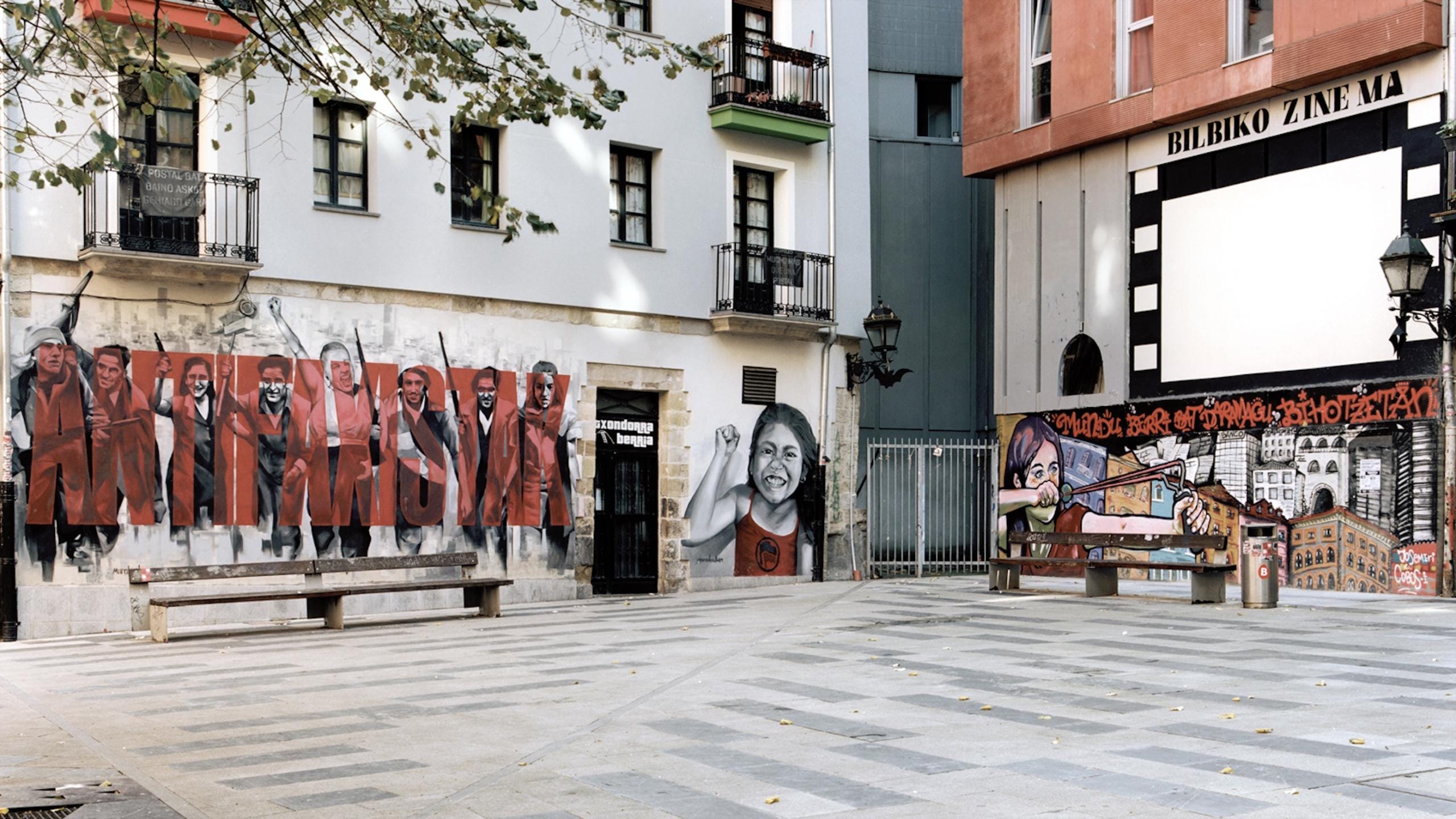
By the middle of the 1980s, as it was becoming clear that targeted political violence had failed to achieve its stated aims, the independence movement took a cultural turn. Uncompromising guitar bands in the region were grouped together under the rubric “Basque Radical Rock”.
Nearly four decades later, this period is still revered in Bilbao. In a scholarly treatment of this movement, Edurne Arostegui writes of his father’s experience back then, a time when Bilbao was a struggling city in Spain’s Rust Belt: “Too many people have forgotten about its past or choose not to remember. Political revolution has been replaced by txikiteo and talk of Michelin-star restaurants.”
The English-language liner notes for Ezin Atera suggest that Orsini has this transformation in mind. After noting that the title “roughly translates to ‘unable to get out’, the band explains that the record is “based on our personal experiences over the past few years. It’s told in a straightforward, linear way, looking back at that huge black hole we ended up in, and how, in the end, making it through actually made us stronger”.
But these personal experiences are also political, since the record “also touches on things like the gentrification of our city, love, and a strong DIY spirit—something that feels like resistance, a way of staying true to who we are, and building things together”.
The record’s final track, “Más fuerte que ayer”, does a great job of communicating this mixture of hope and melancholy: “I want to be stronger than yesterday”.
In other words, Ezin Atera isn’t an exercise in empty nostalgia. Their style is grounded in a highly politicised historical context.
Orsini hearkens back to the 1980s, even though that period was objectively difficult for Bilbao economically, because solidarity can be discerned in culture from that era.
Photograph courtesy of Juan Carlos Viso Gonzalez. Published under a Creative Commons license.