
Safety is an Illusion
Michelangelo Antonioni's Blow-Up

By Charlie Bertsch
On an abstract level, Michelangelo Antonioni’s 1966 film Blow-Up is about trying to turn quantity into quality.
That poses a challenge for audiences. Cinema is so overwhelming from a sensory standpoint that it’s hard to grasp on a conceptual level.
People seeing Blow-Up for the first time are usually baffled. And even hardcore fans like me struggle to discern the big picture.
We remember individual scenes and camera angles, the feel of Herbie Hancock’s score and fashion choices. But explaining what Blow-Up is about is hard.
It’s set in Swinging London. The plot turns on a mystery. Its protagonist behaves like an arrogant asshole. However, these qualities do not explain why the film becomes more compelling over time.
Although I regularly watch clips from Blow-Up when they pop up on YouTube, I hadn’t seen it from start to finish, without pausing, for over fifteen years.
My daughter wanted to watch something with me for my birthday last week. Since she loves learning about the 1960s and wants to better understand postwar European cinema, Blow-Up seemed like a perfect choice.
As I sat next to her, though, I could feel her frustration building. This was a valuable experience, reminding me of how I had felt when I first saw the film in the early 1990s.
Like my daughter, I had a thing for the 1960s. Back then, however, it was much harder to find content on demand. Being able to watch a film from my favourite part of the decade, when psychedelia still wore respectable attire, was a treat, particularly because I could pause and rewind.
Other than where and when the film took place, I knew nothing about Blow-Up. Imagine my excitement, then, to discover that it turned on precisely the sort of detective story I like best. And imagine my befuddlement when the film ended abruptly, without even trying to provide a solution.
In my case, the cinematography and mise-en-scène overcame this problem. For my daughter, who can access documentaries about that time for free on YouTube, they did not. At least, that’s how she felt in the immediate aftermath of watching the film.
With each passing day, though, it became more clear that Blow-Up had made a major impression on her, in spite of her disappointment. No matter how maddening the lack of closure was in the moment, it had given her something to think about. The mystery in the film had transformed into the mystery of the film.
That’s par for the course with Antonioni. One of the best examples is his 1961 film L’Avventura, in which the disappearance of a woman is staged so that we feel as disoriented by it as her companions do. Instead of dramatic irony, in which the audience knows more than the fictional characters, we find ourselves sharing their ignorance.
Instead of providing us with the sense of mastery that was a hallmark of mainstream cinema, Antonioni confronts us with our limitations. By withholding information in his films, he inspires us to compensate for this powerlessness by continuing to reflect on them long after they end.
It’s this dynamic that made Antonioni’s work perfect for the era of home viewing. The pause and rewind buttons provide a measure of control missing in the theatre. Although we can’t change the content on the screen, we can change our relation to it.
Blow-Up is ahead of its time for precisely this reason.
The film’s protagonist, Thomas, played with dark insouciance by David Hemmings, is a professional photographer who shoots hundreds of frames in minutes.
For someone who grew up using digital cameras, this might not seem noteworthy. But in the era when film required chemical development and enlargement, this way of interacting with the world was largely reserved for people who got paid very well for their work.
Thomas resembles a filmmaker more than an amateur photographer, because he can afford to produce “coverage” for important assignments, trusting that he will find the shots he needs afterwards and consigning the rest to the oblivion of the contact sheet.
In contrast to filmmakers of that era, who required assistants to pursue their craft properly, professional photographers could work alone, enabling them to take pictures in difficult circumstances without drawing attention to themselves.
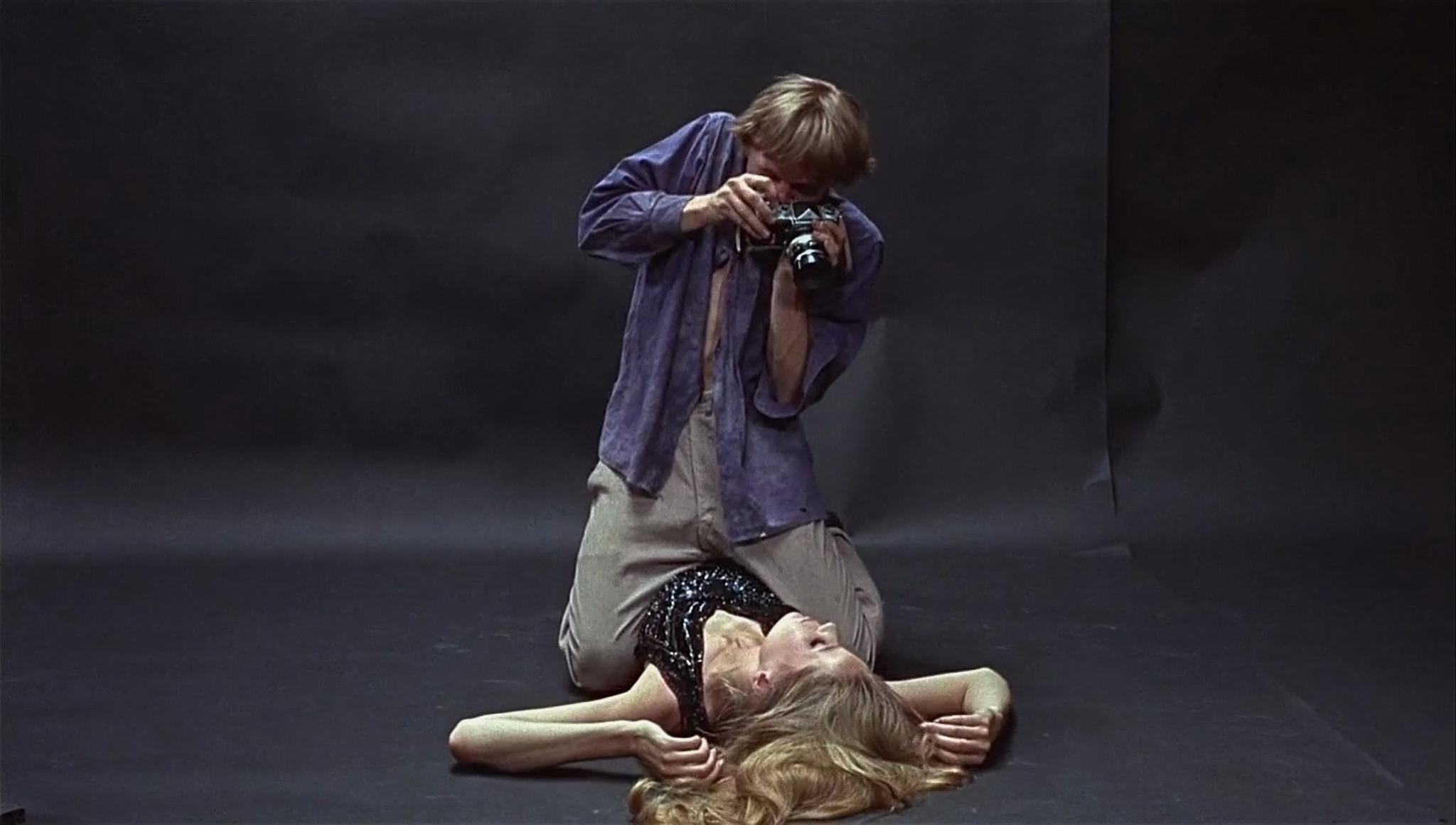
They could also get much closer to their subjects, as Blow-Up shows during a shoot in which Thomas ends up straddling a fashion model, camera in hand, and then whispers in her ear. On the one hand, he captures vastly more content than he can possibly use. On the other hand, he is able to capture scenes that would elude a more intrusive documentarian.
Combine these qualities with the protagonist’s icy aloofness, and you have the perfect figure for a new kind of surveillance society, based less on targeted operations within a vertical chain of command than the production of a vast, horizontally distributed archive of private recordings that can be searched retroactively.
Early in the film, Thomas pays a visit to his friend Bill, an abstract painter. Studying one of his older canvases, Bill declares, “They don’t mean anything when I do them. Just a mess. Afterwards, I find something to hang onto.” Then comes a statement that reverberates through the rest of the film: “It’s like finding a clue in a detective story.”
Detectives, of course, work backwards, sorting through material that is only transformed into evidence once they begin their work.
And that’s what Thomas ends up doing.
While out for a stroll, he sees what appears to be a couple cavorting in a park and begins photographing them. When the woman realises what he is doing, she demands that he give her the film on the spot. After he refuses, she finds out where he lives and tries to seduce it out of him. But he gives her a different roll of film instead.
Thomas is already planning to use some of the photographs for the book he will soon be publishing. Her desperate attempt to get them back piques his interest in their superficially innocuous content.
As he studies the first two prints he has made from the original negatives, he can tell she is distressed in one of them. This initiates the film’s most important sequence, in which he zeroes in on details in the photographs by “blowing up” small portions of the frame until they look like the dots in Bill’s abstract painting.
Despite the fact that it is hard to discern anything concrete in these enlargements of enlargements, Thomas becomes convinced that he has accidentally documented an attempted murder. This suspicion is later confirmed when he returns to the park and finds the corpse of the man he had photographed, indicating that the attempt was successful.
Unfortunately, this happens at night. He doesn’t have his camera with him and therefore cannot document his discovery. To make matters worse, someone breaks into his studio and steals the negatives and every print he made from them, except one he had inadvertently hidden.
By the time Thomas returns to the park at the end of the film, camera in hand, the body is gone. However, he can tell that it had been lying there because the grass has been flattened. This wasn’t some hallucination.
This is the primary explanation for Blow-Up’s lack of closure. Without a body, there is no crime.
More interesting to explore are the story’s implications. Thomas can play the detective because he has captured an apparent crime without realising it. Had he notified the police immediately, they would have found the body, just as he did when he returned to the park for the first time.
But Thomas doesn’t want to hand over the case. For the first time in the film, he isn’t restless and bored. He might not be able to master the complications caused by his discovery, but it gives him a purpose and, with it, temporary self-mastery.
Blow-Up does something similar for its audience.
First-time viewers who watch it straight through might be confused and frustrated, but come away with a sense that they could serve as the corroborating witness Thomas fails to find in the narrative.
Repeat viewers—and those who make liberal use of the remote control when watching the film for the first time—have an opportunity to examine the film in detail, seeing how its different parts relate to one another.
More broadly, they can perceive a deeper meaning to Blow-Up, one that resonates more powerfully now than it did in 1966.
When Thomas meets with his publisher, Ron, early in the film to discuss his book, he mentions having just taken the photographs in the park. At that point, he has no idea that they might contain sinister content. On the contrary, he describes them as “peaceful” and wants to use them as a counterpoint to the bleak photojournalism elsewhere in the book.
By the end of the film, however, he realises that there is no avoiding violence. Parks might be able to provide an experience of pastoral nature, but they cannot keep the snake out of the garden.
Antonioni’s point is both subtle and profound.
Films relate to the real world the way that parks relate to the city. Although they might provide an illusion of escape, they are part of the world, not apart from it.
This is the reason Antonioni returned again and again to stories about a privileged elite, from L’Avventura to his 1982 film Identification of a Woman. His characters are modern-day versions of the storytellers in Boccaccio’s Decameron, who seclude themselves in a villa to avoid the Black Death.
But in Antonioni’s rendering, their safety is an illusion. The scenario Boccaccio describes will eventually turn into Edgar Allan Poe’s “Masque of the Red Death”. Every attempt to create a preserve is doomed to fail. We just need to zoom in far enough to see it.
Screenshot courtesy of Wikipedia. Published under a Creative Commons license.
